C2 Exam
Structure Guide
Four papers, clear timings, and every task type explained: here is the full Cambridge C2 Proficiency exam format in 2026.
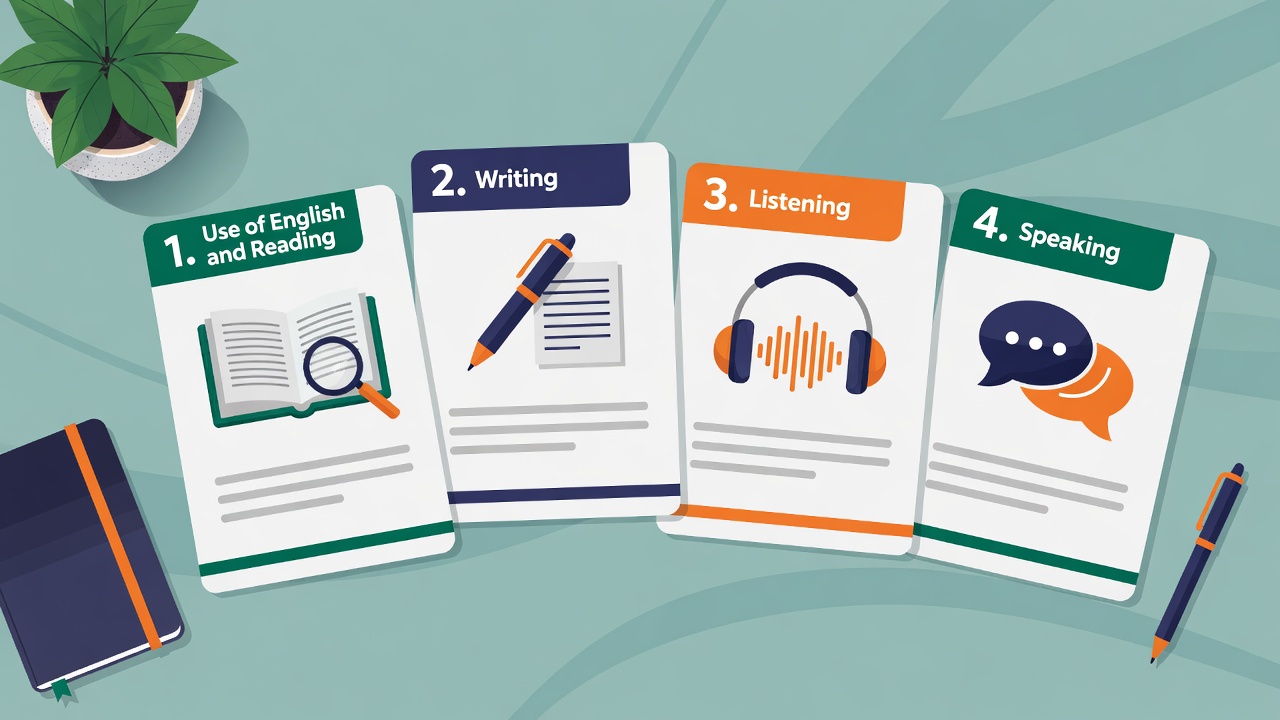
What is the format of the C2 Proficiency exam?
In 2026, Cambridge C2 Proficiency has 4 papers over about 4 hours: Reading and Use of English (90 min, 40%), Writing (90 min, 20%), Listening (about 40 min, 20%), and Speaking (about 16 min, 20%). The full CPE format combines 16 task parts across the four papers.
How to Navigate C2 Proficiency Exam Day
Timeline checklist for written papers and Speaking.
Check the centre timetable — Speaking may be days before or after written papers.
Bring ID, pens, and a watch. Phones are stored; no dictionary allowed.
Allocate ~45 min to Use of English and ~45 min to Reading Parts 5–7.
40–45 min Part 1 essay, 40–45 min Part 2 genre task, plus proofreading.
First listen for gist; second listen for unanswered items only.
The Cambridge C2 Proficiency exam structure can feel intimidating at first, but once you understand how the paper is organised, everything becomes much easier to manage.
C2 Proficiency, formerly known as CPE, is Cambridge's highest-level exam. Its aim is not to check whether you know an endless list of rare words, but whether you can communicate in English with confidence, precision, and naturalness in demanding situations.
Put another way: they do not expect you to sound like a professor of English literature twenty-four hours a day. They expect you to understand complex texts, defend an opinion, write in different styles, follow real conversations, and express yourself fluently even when the topic is unfamiliar.
The exam has four papers:
- Reading and Use of English
- Writing
- Listening
- Speaking
One piece of good news before we begin: you do not need to shine equally in every paper. The final result is calculated from an average of all the papers and is reported on the Cambridge English Scale.
To pass C2 Proficiency, you need to reach at least 200 points on that scale. This means you can compensate for a weaker paper with stronger ones. There is no compulsory minimum score in each section separately: you can score below 200 in one individual paper and still pass if your overall average reaches the required level.
Even so, it helps to have a rough point of reference.
In practice, this means you do not need to "pass" each individual part, but you do need to keep a fairly solid level across all of them. If one section drops too far, for example well below 180, it becomes difficult to make up for it elsewhere.
The key is to aim for balance: you do not need perfection in everything, but you do need general consistency.
The other good piece of news is that the structure is very stable. Once you know what happens in each part, C2 stops looking like a mysterious mountain and starts to feel like a sequence of familiar tasks.
Before going into each paper in detail, it helps to have a quick overview of how the exam is distributed as a whole: how long each paper lasts and how much weight it carries in the final result.
What is the format of the C2 Proficiency exam?
If you searched for C2 exam format, CPE exam format, or Cambridge C2 exam structure, the short answer is simple: there are 4 papers, the written components take about 4 hours in total, and Reading and Use of English carries more weight because it combines two skill areas in one paper. If you want the broader definition of the qualification itself, start with what Cambridge C2 Proficiency is.
| Paper | Duration | Weighting | What it includes |
|---|---|---|---|
| Reading and Use of English | 1 hour 30 minutes | 40% | 7 parts: vocabulary, grammar, and reading tasks |
| Writing | 1 hour 30 minutes | 20% | 2 tasks: essay plus one task choice |
| Listening | About 40 minutes | 20% | 4 parts with different audio task types |
| Speaking | About 16 minutes per pair | 20% | 3 parts with interview, collaboration, and discussion |
This means that Reading and Use of English has more weight than the others because it combines reading comprehension and language use in a single paper. The other three, Writing, Listening, and Speaking, all count the same.
In practice, this does not mean you can neglect any paper, but it does mean it is worth paying special attention to Reading and Use of English, because it can make a major difference to your overall result.
What is in the Reading and Use of English paper?
This is the longest paper and probably the one with the widest variety of tasks. It combines reading comprehension with advanced vocabulary and grammar. It lasts 1 hour and 30 minutes and represents approximately 40% of the overall exam mark. In total, it contains seven parts and 53 questions.
If you want targeted drills after this overview, go straight to our C2 Use of English practice hub and then strengthen your live communication with C2 Speaking practice.
The key to this paper is not reading everything at the same speed. Sometimes you need to read slowly and look for a very specific clue. Other times, it is enough to grasp the general idea. Training both reading modes saves a huge amount of time.
Part 1: multiple-choice cloze
The committee finally made a decision after weeks of debate.
Here you will find a text with eight gaps. For each one, you get four options and must choose the word or expression that fits best.
This part is not just about knowing what a word means. All four options may seem correct if you translate them into Spanish, but normally only one sounds natural in that sentence.
For example, you may know the words decision, choice, option, and alternative. However, a specific expression may almost always go with one of them and sound strange with the others. That is what this task is testing.
The typical mistake is to look at the gap, choose the word that sounds most familiar, and move on. It works much better to read the whole fragment and notice the preposition or verb that appears nearby.
Part 2: open cloze
I had never thought of applying there before.
This part also has eight gaps, but here you are not given any options. You must write one word only in each space.
It is easy to think this part will be simpler because the answers are often short words. In reality, it can be very deceptive. The solution is often not a striking word, but something small like which, yet, of, had, than, or despite.
Before thinking of a specific answer, ask yourself what the sentence needs. Is it missing a preposition? An article? A relative pronoun? A connector between two ideas? Once you identify the grammatical function, you reduce the possibilities dramatically.
Do not write contractions. If the answer is does not, that is two words, not one. Spelling matters in this part too, so check carefully at the end.
Part 3: word formation
First decide the function: noun, adjective, verb, or adverb. Then choose the form that fits the sentence.
In this section, you get a text with eight gaps and a base word next to each one. You must modify it to create the word that fits the sentence.
The word given may need to become a noun, adjective, verb, or adverb. It may also need a negative prefix, a plural form, or more than one change at the same time.
For example, a word like appear can lead to appearance, apparently, disappearance, or unappealing, depending on the context. The trick is not to obsess over the root. Look at the sentence and decide what function the missing word needs to perform.
If there is an article before the gap, you may need a noun. If a verb like seems appears, you probably need an adjective. If the gap modifies a verb, you may be looking for an adverb.
Part 4: key word transformations
This part contains six sentences. You must complete a second sentence so that it has the same meaning as the first, using a compulsory keyword that you cannot change.
Your answer must contain between three and eight words, including the keyword. This matters a lot. If you write nine words, even if the sentence is perfect, it will not count.
Typical structures here include:
- Conditionals and wishes about the past
- Passive and causative forms
- Inversions
- Modal verbs
- Expressions with would rather, had better, or it is high time
- Complex comparatives
- Fixed phrases and collocations
The best way to improve is to build a notebook of complete structures. Do not just write down a word like regret. Write down useful models such as wish I had..., regret doing..., or need not have done....
Part 5: reading comprehension with options
Here you get one long text and six multiple-choice questions.
The questions do not simply ask what happened. They may ask you to identify the writer's attitude, intention, the meaning of a phrase, or the main idea of a paragraph.
The difficulty lies in the fact that several answers may contain words similar to those in the text. Do not fall into the trap of choosing an option just because it repeats an expression you saw. What matters is whether it answers the question exactly.
When reading a question, notice words like attitude, purpose, suggests, implies, or main point. They tell you what kind of answer you need to look for.
Part 6: gapped text
In this part, there is a long text from which seven paragraphs have been removed. You must place each paragraph in the correct gap.
This task feels like a puzzle, and in a way it is. But you do not need to understand every word to solve it. You need to detect how the ideas connect.
Look for clues such as:
- A pronoun that needs to refer back to something mentioned earlier
- A connector like however, therefore, meanwhile, or for example
- A question that is answered in the following paragraph
- A general idea followed by an example
- An opinion followed by an explanation or a consequence
Do not place a paragraph just because it is about the same topic. It has to fit both what comes before and what comes after.
Part 7: multiple matching
Question: felt disappointed
Text: their expectations were not met
In this final part, you may find several short texts or one long text divided into sections. You get ten questions and must match them to the correct person, paragraph, or section.
This task rewards speed. Read the questions before you start searching for answers and mark two or three key words in each one. Then locate the part of the text that deals with that idea.
Remember that the exam often paraphrases information. If a question mentions "feeling disappointed", the text may talk about "expectations that were not met". Do not always look for the same words. Look for the same meaning.
General tips for Reading and Use of English
Do not leave answers blank. There is no penalty for getting a question wrong, so it is always worth making a reasoned choice.
Practise under real time conditions. It is one thing to understand a text at home with coffee and a dictionary, and quite another to solve it after an hour of exam pressure.
It also helps to learn vocabulary in complete chunks. Do not memorise only issue. Memorise expressions like raise an issue, address an issue, a pressing issue, or an issue arises.
What is in the Writing paper?
The Writing paper lasts one hour and thirty minutes and has two tasks. Both count the same, so it is best to divide your time evenly.
Here, they do not assess only your grammar. It also matters that you answer the task exactly, organise your text well, and use the right tone.
The four assessment criteria are very easy to understand:
- Content
- Communicative Achievement
- Organisation
- Language
Part 1: compulsory essay
In this task, there is one question only. You are given two points for discussion and must explain which one you consider more important, justifying your opinion.
The goal is not to write a huge introduction and then comment on the two ideas as if they were separate islands. The aim is to connect them, show nuance, and reach a reasoned conclusion.
A simple structure could be:
- A brief introduction presenting the topic
- Development of the first idea
- Development of the second idea and comparison
- A clear conclusion on which one is more relevant
You do not need spectacular words. It is much better to write a major concern naturally than to force a sophisticated expression you do not fully control and end up with an odd sentence.
Part 2: one task to choose
You will have three options and choose one. It may be an article, an informal letter, a formal letter, a report, or a review.
Your choice matters. An interesting topic does not make up for a format you do not know how to handle. Before deciding, think about which of these text types feels most comfortable for you.
If writing is the paper you most want to improve after understanding the format, the dedicated C2 Writing guide is the best next step.
Article
An article is usually aimed at readers of a magazine, website, or publication. It can be close, dynamic, and even slightly creative.
There is no need to overuse rhetorical questions or exclamation marks. A good article has rhythm, but it is still clear and well organised.
Formal or informal letter
A formal letter requires distance, politeness, and careful register. An informal letter is more personal and flexible.
The most common mistake is mixing registers. Do not start with Dear Sir or Madam and end with Cheers!
Report
A report usually has a practical aim: analysing a situation and proposing improvements or recommendations.
Subheadings are your friends. They make the text easier to read and help your ideas look organised. Not every sentence needs to be complex. In a report, clarity is gold.
Review
A review combines description, evaluation, and recommendation. It may be about a book, a film, a place, an experience, or a product.
Do not stop at "I liked it a lot." Explain why it worked, who you would recommend it to, and what could be improved.
General tips for Writing
Spend a few minutes planning each task. A four-line outline can save you from repeating ideas or forgetting an important part of the question.
Avoid learning complete texts by heart. It is obvious when a response is trying to force a memorised template into an unsuitable topic. It is much better to have flexible structures and adapt them to the task.
Before handing your answer in, check especially:
- Verb tenses
- Articles
- Prepositions
- Subject-verb agreement
- Punctuation
- Register
- Repetition of words
What is in the Listening paper?
Listening lasts approximately 40 minutes. You hear each recording twice. In total, there are four parts and 30 questions.
This paper is not only about understanding words. You also need to detect attitude, intention, irony, changes of opinion, and details expressed indirectly.
For focused practice after this structure guide, use our C2 Listening practice hub or the full C2 Listening practice guide.
Part 1: three short extracts
You will hear three extracts of about one minute each. Each one has two multiple-choice questions.
The recordings may be conversations, interviews, comments, or fragments of programmes. The correct answer is rarely a sentence repeated word for word.
Use the preparation time to understand the difference between the options. Sometimes all three seem reasonable, but one focuses on an emotion, another on a reason, and another on a consequence.
Part 2: sentence completion
You will hear one person speaking for about three or four minutes. You must complete nine sentences with information from the audio.
The answers are usually single words or short noun phrases. Do not try to improve the sentence with your own wording. It is better to write exactly what you hear.
Before the recording starts, look at whether the gap probably needs a name, a number, a place, a cause, or an adjective. That small prediction prepares your ear in advance.
Part 3: long conversation
You will hear a conversation lasting three or four minutes between two or more speakers. Then you answer five multiple-choice questions.
Here it often happens that one speaker seems to support an idea at first and then later qualifies it. Do not choose an answer just because you heard one clear sentence. Listen to the whole exchange.
Pay attention to expressions like I used to think..., at first I assumed..., or I would not go that far. They often signal a change of opinion.
Part 4: five speakers
You will hear five short monologues of around 35 seconds each. You must complete two matching tasks at the same time.
This part demands concentration because all the speakers discuss the same topic, but from different experiences. One person may feel proud, another relieved, another disappointed, and another surprised.
Do not focus only on the concrete detail. Ask yourself how that speaker feels and what they are trying to convey.
General tips for Listening
Listen to real English regularly: interviews, documentaries, talks, podcasts, and debates. You do not need to understand everything from day one. The goal is to get used to different voices, rhythms, and accents.
During the first listening, answer what you can. During the second, review and complete. Waiting for the second round often increases stress.
In sentence-completion tasks, also check the grammar around the gap. A word may sound correct but still not fit the sentence.
What is in the Speaking paper?
The Speaking test is usually done with another candidate and two examiners. It lasts about 16 minutes if you take it in pairs.
It is not a competition against your partner. In fact, listening well, reacting to their ideas, and helping the conversation move forward are important parts of the paper.
The examiners assess your grammar, vocabulary, discourse organisation, pronunciation, and interaction. They are not looking for a perfect accent. They are looking for clarity, naturalness, and the ability to sustain a conversation.
To see how this live paper fits into the wider challenge, compare it with the full C2 Reading practice guide and the article on whether C2 is the hardest English exam.
Part 1: opening interview
The examiner asks general questions about studies, work, interests, travel, habits, or experiences.
You do not need to tell your whole life story. But try to avoid one-word answers. Instead of saying Yes, I do, add a reason, an experience, or a short example.
The goal is to sound spontaneous, not recited. A simple, natural answer works better than a sentence full of vocabulary you would not normally use.
Part 2: collaborative task with images
You may be given between one and seven images. First you answer a brief question about some of them. Then you have to talk together and make a decision.
Collaboration matters. You do not have to agree all the time. You can disagree politely:
- I can see your point, but...
- That is true to an extent. However...
- Perhaps we should also consider...
- Would you agree that...?
- The main advantage seems to be...
Do not obsess over reaching a perfect decision. What matters is showing that you can negotiate, justify your ideas, and react to another person.
Part 3: individual turn and discussion
Each candidate speaks for about two minutes in response to a specific question. Then they briefly comment on what their partner said. Finally, the examiner opens a discussion on a related theme.
In your individual turn, you do not need to cover every element on the card. Choose the ones that help you build a clear answer with examples.
During the final discussion, listen for real. You can disagree, but show that you understood the other candidate's point before adding your own.
General tips for Speaking
Do not memorise complete answers. Examiners can ask very different questions, and memorised responses usually sound stiff.
Practise with another person whenever possible. A big part of this paper is reacting in real time, and that is not something you train by speaking alone in front of the mirror.
It also helps to record yourself. When you listen back, you will notice repetition, fillers, long pauses, or words you pronounce with uncertainty.
How difficult does the format feel once you know it?
Personal experiences vary, but a few ideas come up again and again among people preparing for C2.
The first is that doing full mock exams under real time conditions feels uncomfortable at the beginning, but it is what reveals the real problem. Sometimes the issue is not English level, but speed, mental stamina, or lack of habit under pressure.
The second is that Writing and Speaking often need outside correction. Doing grammar exercises on your own is useful, but it does not always show whether your text has the right tone or whether you are participating effectively in conversation.
It is also common to discover that the exam is not passed by trying to sound extremely sophisticated all the time. The candidates who communicate best usually use a varied vocabulary, yes, but also one that is clear, precise, and natural.
The practical lesson is simple: do not chase impossible sentences. Chase well-built answers.
How should you prepare for the C2 exam format?
A balanced preparation plan can be organised like this:
- Work on Reading and Use of English several times a week under timed conditions.
- Practise Writing regularly and get feedback whenever possible.
- Listen to real English every day and combine it with exam-style Listening tasks.
- Train Speaking with a partner, tutor, or recorded practice.
- Do full mock exams to build stamina and identify weak points.
When you correct an exercise, do not just look at the answer. Classify the mistake:
- Vocabulary
- Grammar
- Lack of attention
- Lack of time
- Misunderstanding the question
- Spelling
- Text structure
That helps you detect patterns. If you miss many transformations, you may need more structural grammar practice. If you lose marks in Listening Part 2, you may need to train dictation and spelling. If your Writing responses are too short, you may need to plan before writing.
What should you do on the day of the exam?
Arrive early, bring whatever your centre tells you to bring, and read the instructions calmly. Do not try to prove everything in the first question.
If one task gets stuck, make a reasonable decision and move on. Spending five minutes fighting with one transformation can cost you easy marks elsewhere.
Remember these ideas:
- You do not need to be perfect in every paper.
- Time management matters almost as much as language level.
- Staying calm helps you more than forcing sophistication.
- Consistency beats brilliance in one isolated part.
C2 Proficiency is demanding, but it is not an exam reserved for people who have spoken English since birth. It is an exam that rewards intelligent practice, consistency, and the ability to stay calm.
Knowing the format well, practising each task type, and learning from your mistakes turns something huge into something much more manageable. The goal is not to look perfect. The goal is to show that you can communicate confidently even when English gets serious.
Which Official Sources Define C2 Exam Structure?
- Cambridge University Press & Assessment: C2 Proficiency exam overview — retrieved 2026-08-11
- Cambridge University Press & Assessment: C2 Proficiency Teachers Handbook — retrieved 2026-08-11
- Cambridge University Press & Assessment: Cambridge English Scale — retrieved 2026-08-11