What Is
Cambridge C2 Proficiency?
If you have seen CPE, C2, or Cambridge Proficiency on a job ad or university page and wondered what it actually means, this is the plain-English answer for 2026.
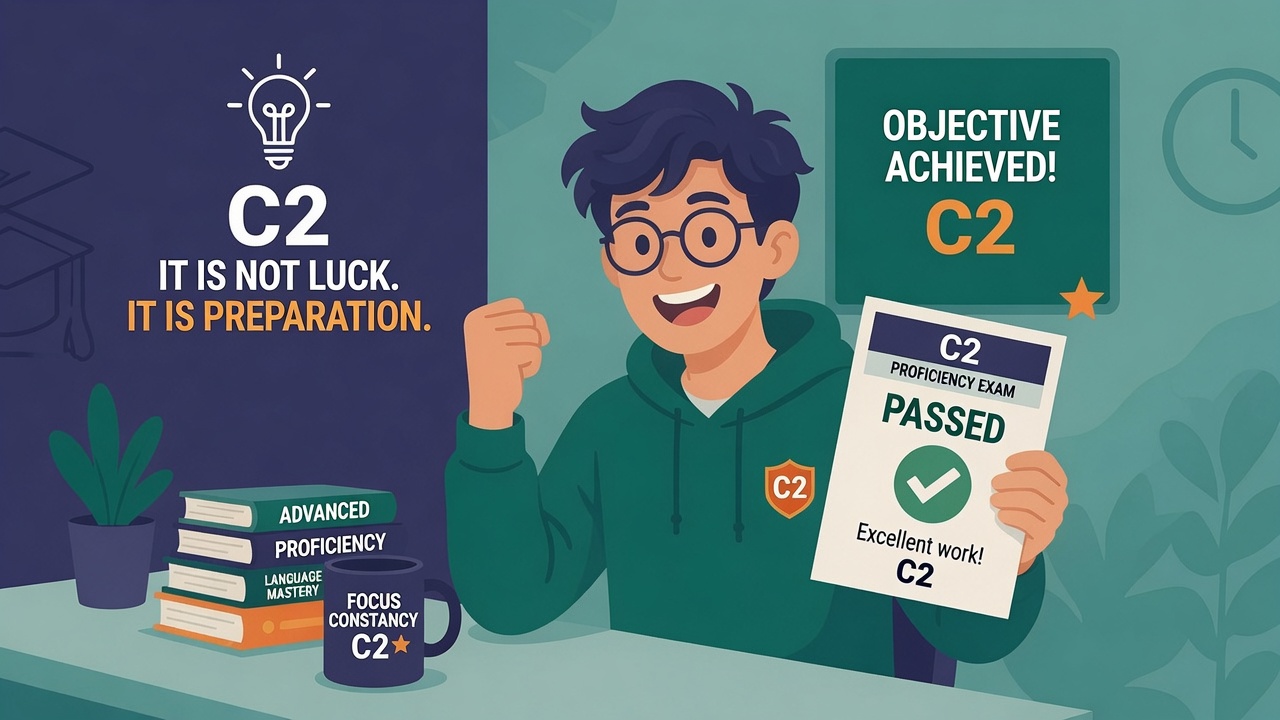
What is Cambridge C2 Proficiency?
Cambridge C2 Proficiency (CPE) is Cambridge's highest-level English qualification. It targets CEFR C2, has four papers, takes about four hours, and the certificate itself does not expire. Official C2 results start at 200 on the Cambridge English Scale.
Cambridge C2 Proficiency: Everything People Usually Ask (Explained Simply)
If you're thinking about taking the Cambridge C2 Proficiency (the exam formerly known as CPE), it's normal to have a lot of questions. It's the highest level of the Cambridge exams, and many people ask themselves exactly the same questions you do. In this article, I'll explain what this exam entails, how difficult it is, what alternatives are available, whether or not it's worth it, what sections it includes, how to prepare, and much more.
practice-english.com is an independent learning resource and is not affiliated with Cambridge University Press & Assessment.
What Is the Cambridge C2 Proficiency?
It's the highest-level English exam offered by Cambridge. It serves to demonstrate that you have a very advanced command of the language, sufficient to study at an English-speaking university at the master's or doctoral level, work in professional settings where English is the primary language, or simply prove that you're very fluent in it.
Unlike other exams such as the IELTS or TOEFL, this certificate does not expire. Once you pass it, it's valid forever. You can take it in digital or paper format, and it lasts about four hours in total.
Many people choose it because it is widely recognized around the world, particularly in high-level academic and professional contexts, especially in Europe. If you want the detailed paper-by-paper breakdown, use the exam structure guide linked at the end of this article.
What does C2 mean in English?
C2 English level means the highest level of English on the CEFR scale. It means you can understand almost everything you read or hear, express complex ideas fluently, and control tone, nuance, and register with very high precision. On the CEFR scale, C2 is above C1 Advanced and far beyond everyday conversational fluency.
In practical terms, C2 is the level expected for demanding academic writing, advanced professional communication, and precise discussion of abstract or specialised topics. It is not just "good English"; it is the ability to use English accurately when the ideas, texts, and situations are difficult.
How does it differ from the C1 Advanced (CAE)?
This is one of the most common questions.
Cambridge English Scale: C1 vs C2
Both exams report on the same 180-230 scale. The difference is what each score band certifies.
Usually certifies strong advanced English across 180-199, with Grade A extending into 200-210.
On C2 Proficiency, 180-199 does not fully pass C2. Cambridge reports a Level C1 certificate instead.
Full C2 starts at 200: Grade C (200-212), Grade B (213-219), and Grade A (220-230).
The C1 Advanced is already a very good level. It allows you to gain admission to many universities and land jobs that require strong English skills.
The C2 Proficiency goes one step further. It's not that it's "much, much harder," but it does require greater precision, a greater ability to express complex ideas naturally, and a higher level of mastery of advanced structures and vocabulary. For a focused comparison, read our C2 Proficiency vs C1 Advanced guide.
In practice, the difference is most noticeable in the grammar and vocabulary section (known as "Use of English") and in the quality expected in the writing tasks. If you already have a fairly solid C1 level, the jump to C2 is manageable with good preparation. If your level is a bit weaker, many people recommend taking the C1 first and then deciding.
On forums, the common question is: "Is it worth going straight to C2, or should I take the C1 first?" The most common answer is that it depends on why you need it and how much time you have to prepare.
Is it worth getting the C2?
That's the million-dollar question. The exam costs around 220-260 euros, depending on the country and the testing center, so it's normal to think it over carefully.
| Reasons to take C2 | Reasons not to prioritise it yet |
|---|---|
| You need it for a clear goal such as postgraduate study, a high-level job, or formal proof of top-tier English. | A strong C1 Advanced result already covers what you need for most jobs or academic applications. |
| You want a certificate that never expires and can stay on your CV for life. | Your budget is tight and the exam fee would be hard to justify right now. |
| You are motivated enough to prepare properly and treat it as a serious project. | You do not yet have the time, consistency, or current level needed to prepare well. |
| You value the personal achievement of reaching the highest Cambridge level. | You already prove your English through study, work, or daily professional use, so the certificate adds less value. |
In my experience, it depends a lot on your medium- and long-term plans. If you're not sure what you'll use it for, sometimes it's better to save your money or time. For a deeper cost-benefit analysis, compare this section with Is C2 Proficiency worth it?.
How difficult is the exam?
It's a challenging exam, but not impossible. What surprises people the most is that even some native speakers find parts of it difficult, especially the writing section and the grammar and vocabulary sections. Obviously, for a native speaker, the speaking and writing sections would be a breeze, but both the reading and "use of English" sections would be a bit more challenging because they don't rely on set phrases and everyday vocabulary.
Relative candidate volume across Cambridge levels
Official C2 Proficiency score boundaries
It's not just about "speaking English well." Precision, the ability to structure ideas, and the use of sophisticated yet natural language are highly valued. The writing section is the one people most often mention as difficult, because you have to write well-organized essays in a short amount of time and with a high level of detail.
If your English is already good and you've practiced the exam format, it's entirely manageable. If you still struggle to express complex ideas or make frequent grammar mistakes, you'll need more time to prepare.
The key is to take many full-length practice exams. That way, you'll realize where you really stand and what you need to improve.
How do I know if I'm ready?
Don't waste your exam fee only to find out you're not ready yet. The most reliable way is to take a full-length practice exam under real-time conditions. If you want a quick first signal, start with our C2 Use of English practice and see how close your accuracy already is to exam level. You can also use the C2 scoring guide to understand what your practice scores mean.
How should you prepare?
The most effective preparation usually combines three things: official materials, full-length practice exams, and targeted work on the sections you find most challenging. On our website, we have a section dedicated to recommended materials, but here are some of the most commonly used by students. For skill-specific work, use targeted hubs such as C2 writing practice and C2 listening practice alongside full papers.
Recommended materials:
- The official C2 Proficiency Teachers Handbook, which explains the format, assessment criteria, and task types in detail.
- The official Cambridge C2 Proficiency overview and sample papers, which are the best starting point for free exam-authentic material.
- The official Write & Improve tool from Cambridge, which is especially useful for regular writing practice.
- English Vocabulary in Use - Advanced, a Cambridge University Press book that helps with lexical range across Reading, Writing, and Use of English.
- English Grammar in Use - Advanced, a Cambridge University Press grammar reference for cleaning up high-level structural mistakes.
- English Collocations in Use - Advanced, another Cambridge title that is particularly helpful for Part 1 and more natural writing.
- Our best books for C2 Proficiency guide, where we rank the most useful books and practice materials in one place.
How long does it take to go from C1 to C2?
Going from a solid C1 to being ready to take the C2 Proficiency exam usually takes between 3 and 6 months of consistent study, depending on how much time you can dedicate to it each week and how well-established your current level really is.
If you already handle English well in real-life situations, read complex texts without much difficulty, and write with some fluency, by dedicating about 10-15 hours a week and focusing primarily on full-length practice exams, the Writing paper, and advanced grammar and vocabulary work, most people can reach the level needed to take the exam with a good chance of passing.
If your C1 level is more borderline or you have less time available, you'll likely need the full 6 months or even a little longer. The important thing is not so much "studying general English" as getting used to the exam format and polishing the sections where you tend to lose the most points.
The most important thing is to take several full-length, timed practice exams. It's not enough to just study grammar or vocabulary in isolation. You have to get used to the pace and the types of tasks you'll face on test day.
If you prefer to prepare on your own, that's entirely possible. In fact, it's hard to find language schools that offer preparation for this level, since very few people prepare for such a complex exam. If you feel more confident with some help, a good teacher who's familiar with the C2 format can make a big difference. You can try Preply.
What's the exam like? (The four sections explained simply)
The exam has four papers. They all matter, but they test different aspects of high-level English. The table below gives you the fastest possible overview.
| Paper | Time | What you do | Why it matters |
|---|---|---|---|
| Reading and Use of English | 90 minutes | Read dense texts, complete cloze tasks, do word formation, and rewrite sentences with precision. | This is where vocabulary control, grammar accuracy, and attention to nuance really show. |
| Writing | 90 minutes | Write two tasks: first an essay, then a second task such as an article, report, review, or letter. | Examiners look for clear structure, strong register control, and mature idea development. |
| Listening | About 40 minutes | Listen to interviews, conversations, and monologues, then answer detailed comprehension questions. | You need to follow meaning, attitude, and implied ideas, not just isolated words. |
| Speaking | About 16 minutes per pair | Answer personal questions, compare visual prompts, collaborate with another candidate, and discuss ideas in depth. | This paper tests fluency, interaction, range, and your ability to express complex ideas naturally. |
The exam can be taken on a computer or on paper. The content is the same; only the delivery format changes. If you want to try realistic tasks before choosing a route, start from the exams hub.
Common mistakes about C2
These are the misunderstandings that create the most confusion when people compare C2 Proficiency with other English qualifications:
- C2 does not mean native speaker. It means you can use English at the highest CEFR level, but native speakers and C2 learners are not the same category.
- CPE does not expire after two years. Cambridge C2 Proficiency certificates are valid for life. If you need the details, read our C2 certificate expiry guide.
- C1 Advanced Grade A is not the same as C2 Proficiency. A Grade A in C1 Advanced shows performance at C2 level on that exam, but it is not the same qualification as passing C2 Proficiency.
- IELTS 8.5-9 and C2 are not identical. They can both indicate extremely high English ability, but they use different scoring systems, formats, and validity rules.
Other frequently asked questions
Is Cambridge C2 the same as CPE?
Yes. Cambridge C2 Proficiency is the modern name for the exam that many teachers and candidates still call CPE. CPE stands for Certificate of Proficiency in English, the older name of the qualification.
What does C2 mean in English?
C2 means the highest CEFR level of English. A C2 user can understand complex spoken and written English, express ideas fluently and precisely, and adapt language to academic, professional, and specialised contexts.
Does the certificate expire?
No. Once you pass, it's valid for life.
Can I take the exam if I'm a native or near-native speaker?
Yes, but don't get too confident. Many native speakers still need to prepare, especially for the writing section and the grammar and vocabulary exercises.
What happens if I don't pass?
You can retake the exam whenever you want. There's no limit on the number of attempts.
Where can I find official information?
The best source is always the Cambridge English website. There you'll find free sample exams, candidate guides, and everything you need to prepare.
In conclusion
The Cambridge C2 Proficiency is a challenging exam, but with good preparation, it's entirely achievable. The key is to be honest with yourself about your current level, practice extensively with real exams, and be clear about why you need it.
If your goal is clear and you're willing to put in the time, it can be a very good investment. If you don't yet have a strong reason or prefer to take it step by step, the C1 Advanced is still an excellent certificate and more accessible for many people.
Are you thinking about taking the exam soon? Do you have any specific questions about any part of the exam or how to prepare? Let me know, and I'll help you in more detail.
Good luck with your English! You'll make progress little by little.
Which official Cambridge and CEFR sources support this guide?
- Cambridge University Press & Assessment: C2 Proficiency exam overview — retrieved 2026-08-11
- Cambridge University Press & Assessment: C1 Advanced exam overview — retrieved 2026-08-11
- Cambridge University Press & Assessment: C2 Proficiency Teachers Handbook — retrieved 2026-08-11
- Cambridge University Press & Assessment: Cambridge English Scale — retrieved 2026-08-11
- Cambridge University Press & Assessment: C2 Proficiency grade statistics — retrieved 2026-08-11
- Cambridge: Write & Improve — retrieved 2026-08-11