Multiple Choice:
Mastering Collocations & Idioms
Part 1 of the Use of English paper might look simple — four options, pick one — but at C2 level, all four options are grammatically correct. The difference is always about meaning, collocation or register.
How do you solve C2 Proficiency Part 1 Multiple Choice Cloze?
In 2026, Cambridge C2 Part 1 has 8 gaps with four options each — all grammatically correct. Read the full text first, eliminate two distractors, then choose the answer with the most natural collocation or idiom. Spend about 12 minutes total on this section.
1What Exactly Does Part 1 Test?
Part 1 consists of a text with 8 gaps. For each gap, you choose from four options (A, B, C, D). The correct answer always depends on one of these categories:
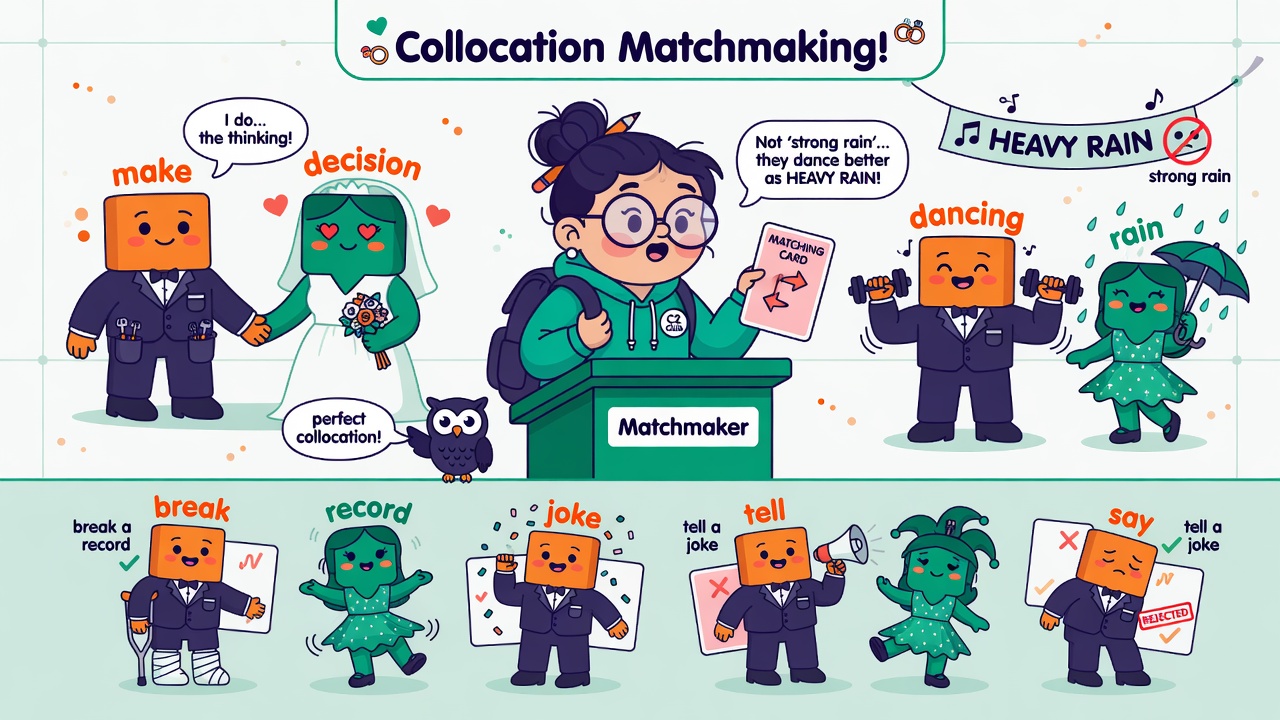
Which word "sounds right" with the surrounding words (e.g. make a decision, not do a decision)
Set expressions with meanings that cannot be guessed literally (e.g. the tip of the iceberg)
Multi-part verbs where the particle changes the meaning (e.g. put up with vs put off)
Words that are synonyms but differ subtly (e.g. slim vs thin vs slender)
2How Does the 4-Step Elimination Strategy Work?
The 4-Step Elimination Strategy for C2 Multiple Choice Cloze
A systematic method to tackle even the most difficult items in Part 1.
Never look at the gap in isolation. Read 5 words before and 5 words after the gap to understand the full context.
Notice prepositions, articles and surrounding verbs. Many collocations are locked to specific prepositions.
Usually two options are clearly wrong because they don't collocate. Remove these first to improve your odds.
Say both sentences out loud (mentally). Which one sounds like natural, native English?
Never look at the gap in isolation. Read 5 words before and 5 words after the gap to understand the full context.
Notice prepositions, articles and surrounding verbs. Many collocations are locked to specific prepositions (e.g. "consistent with", not "consistent to").
Usually two options are clearly wrong because they don't collocate. Remove these first to improve your odds.
Say both sentences out loud (mentally). Which one sounds like natural, native English? Trust that instinct — it's usually right at C2 level.
3Which Collocations Appear Most Often in Part 1?
These verb-noun collocations appear repeatedly in CPE Part 1 exams. Memorise them as chunks, not individual words:
| Collocation | Common Distractor | Context |
|---|---|---|
| make a decision | do a decision | After long deliberation, she ___ a decision. |
| reach an agreement | arrive at an agreement | Both sides finally ___ an agreement. |
| raise awareness | grow / lift awareness | The campaign aimed to ___ awareness. |
| conduct research | do / make research | Scientists ___ extensive research. |
| set a precedent | create / make a precedent | The ruling ___ a landmark precedent. |
| come to terms with | accept / settle with | She struggled to ___ her diagnosis. |
| take something for granted | assume / take as given | We often ___ clean water for granted. |
| draw a conclusion | make / take a conclusion | From the data, we can ___ this conclusion. |
4What Pro Tips Boost Your Part 1 Score?
At C2, avoid or is not the same as shun, prevent is not the same as hinder — context determines which is correct.
Often the options differ only in the preposition they require. Check what follows the gap (e.g. "insist on doing" vs "persist in doing").
Some options are too informal for a formal text (e.g. "get" vs "obtain"). Read the tone of the passage before choosing.
Each question is worth 1 mark. Don't lose 5 minutes on one question. Move on, mark it, and come back if time allows.
Ready to Test These Strategies?
Apply everything from this guide with our free Part 1 practice exams. Immediate feedback on every answer.
Start Part 1 Practice NowWhere Are Part 1 Rules Defined Officially?
- Cambridge University Press & Assessment: C2 Proficiency Teachers Handbook — retrieved 2026-06-11
- Cambridge University Press & Assessment: C2 Proficiency exam overview — retrieved 2026-06-11
- Cambridge University Press & Assessment: Cambridge English Scale — retrieved 2026-06-11
Written for Cambridge C2 candidates by José Luis García and checked against the official sources listed above. Last updated: March 2026.