Open Cloze:
Grammar Patterns That Always Appear
Part 2 requires you to write ONE word for each of 8 gaps — no options given. The correct answers are almost always grammatical words, not vocabulary. Knowing which patterns to look for is everything.
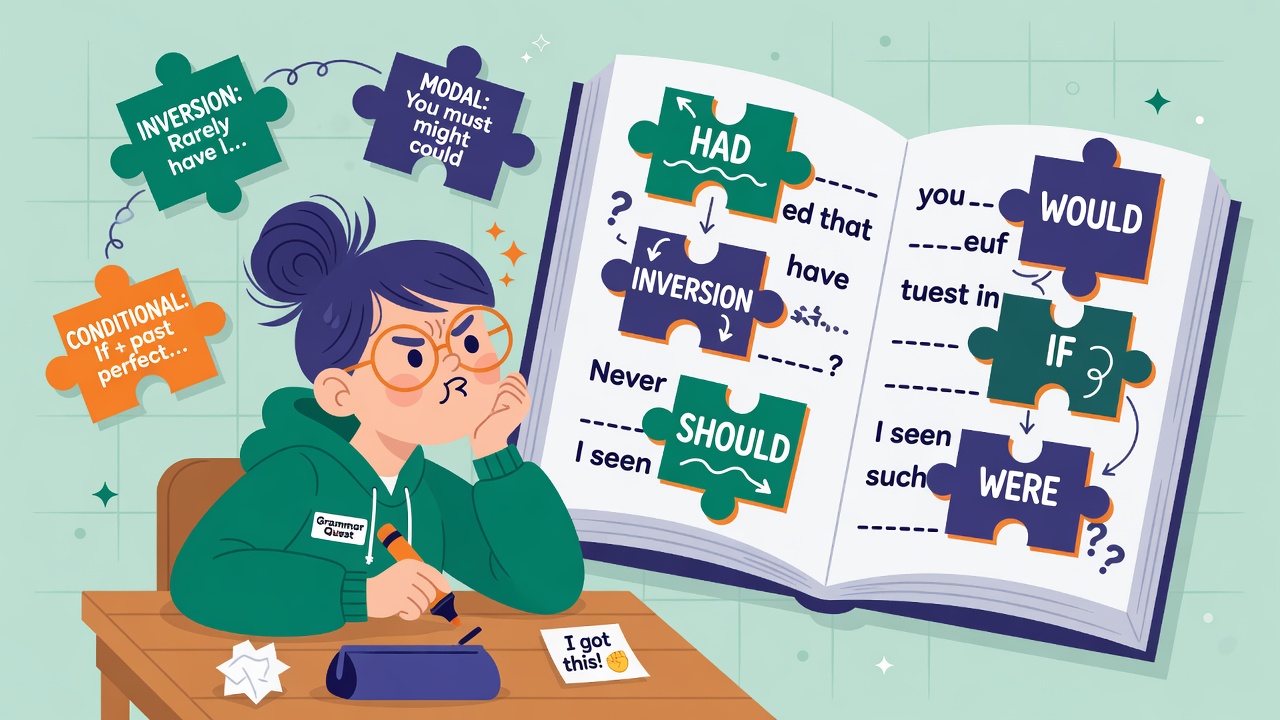
What is the best strategy for C2 Proficiency Part 2 Open Cloze?
In 2026, Cambridge C2 Part 2 has 8 gaps requiring exactly one word each — usually prepositions, articles, auxiliaries, or discourse markers, not vocabulary. Read the full sentence, identify the grammatical pattern, and spell carefully; contractions count as two words.
How to Master C2 Proficiency Part 2 Open Cloze
A proven step-by-step method to identify grammar patterns and fill gaps accurately in the Open Cloze section.
Never focus on the gap in isolation. Read at least the sentence before and after to understand the overall meaning and grammatical structure required.
Look at what comes immediately before and after the gap. Is it testing a preposition, auxiliary verb, discourse marker, relative pronoun, or fixed expression?
Many gaps test dependent prepositions, verb + preposition combinations, or adjective + preposition patterns that are fixed in English.
If the gap starts a new sentence or clause, it is very often a discourse marker showing contrast, addition, result, or concession.
Once you have a candidate word, check it fits grammatically and that you can spell it correctly (many C2 candidates lose marks on spelling).
Always verify that the completed sentence sounds completely natural and follows C2-level grammatical accuracy.
1Why Is Part 2 Almost Never About Vocabulary?
Unlike Part 1, Part 2 gaps are almost always filled with structural or functional words — not nouns, adjectives or main verbs. This means you're being tested on grammar, not vocabulary.
2What Are the 7 Most Tested Open Cloze Patterns?
Fixed Prepositions with Adjectives/Verbs
Many adjectives and verbs lock to a specific preposition. These are tested heavily.
- dependent on / dependent upon
- accustomed to + -ing
- responsible for
- consist of (not consist in)
- result in (not result to)
Discourse Markers & Connectors
A gap at the start of a sentence or clause usually requires a linker. Read both sides of the gap to understand the logical relationship.
- Contrast: nevertheless, nonetheless, whereas, albeit
- Addition: furthermore, moreover, in addition
- Concession: although, even though, despite
- Result: consequently, therefore, thus
Relative Clauses
When there is no relative pronoun before a verb, a gap often requires which, who, whose, or where.
- "…the theory ___ was proposed in 1980…" → which/that
- "…the scientist ___ hypothesis was rejected…" → whose
- "…the city ___ he was born…" → where/in which
Passive & Perfect Constructions
A gap between a pronoun and a past participle often requires "have" or "be" in the right form.
- "She ___ been working here for years." → has
- "The bridge ___ constructed in 1920." → was
- "They ___ been told to wait." → had
Quantifiers & Determiners
Watch for uncountable vs countable noun signals that indicate which determiner is needed.
- "___ great deal of" (a)
- "___ number of" (a)
- "the majority ___ people" (of)
- "___ few exceptions" (a/the)
3Which Mistakes Cost C2 Candidates the Most Marks?
Only ONE word is allowed. Contractions (it's, don't) count as two words and will be marked wrong.
"The" is one of the most commonly needed words. Scan for places where a superlative or specific reference needs it.
"arrive at" a place (not arrive to). "attend" takes no preposition. "participate in" (not participate at).
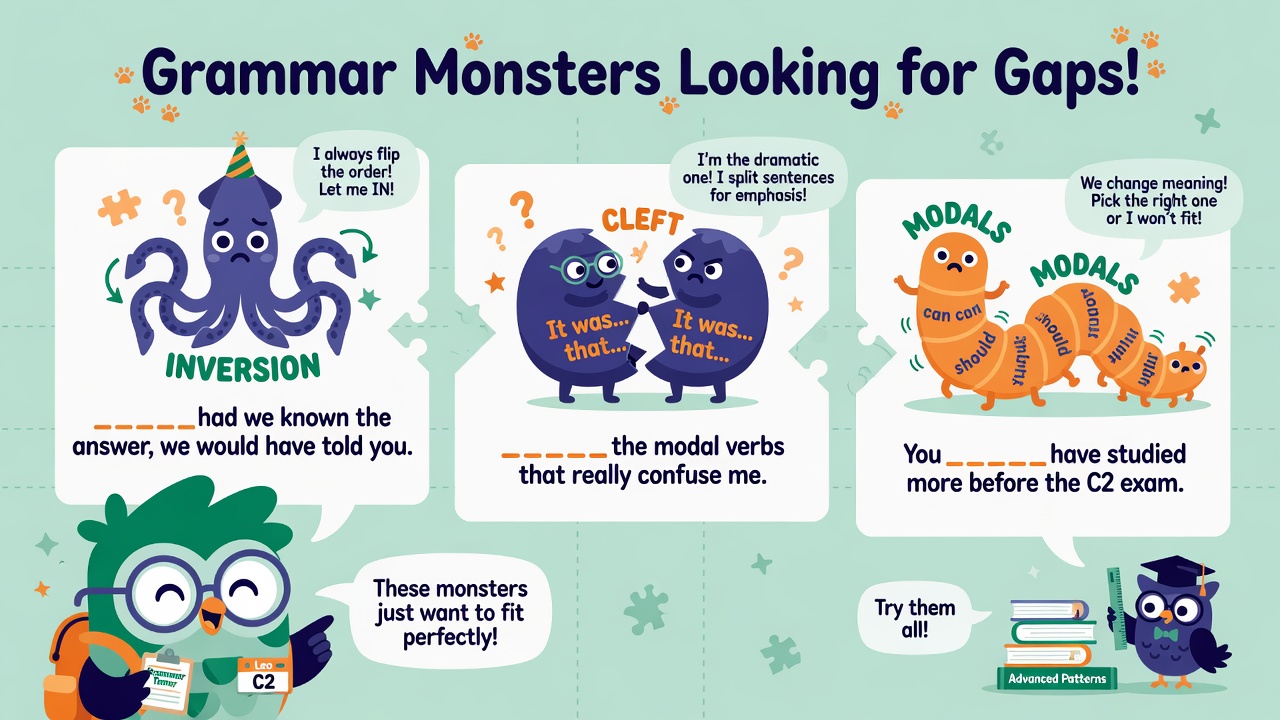
Ready to Practice Open Cloze for Free?
Apply these patterns with 30+ free Open Cloze exams — no registration needed.
Start Part 2 Practice NowWhere Are Open Cloze Rules Defined Officially?
- Cambridge University Press & Assessment: C2 Proficiency Teachers Handbook — retrieved 2026-06-11
- Cambridge University Press & Assessment: C2 Proficiency exam overview — retrieved 2026-06-11
- Cambridge University Press & Assessment: Cambridge English Scale — retrieved 2026-06-11
Related C2 Use of English Guides
Written for Cambridge C2 candidates by José Luis García and checked against the official sources listed above. Last updated: March 2026.