B2 Use of English: Parts 1–4 Complete Guide
The B2 First Use of English tasks test whether grammar and vocabulary are available quickly enough to use in context. They sit inside the 75-minute Reading and Use of English paper and make up Parts 1–4. Together, these parts reward collocation knowledge, grammatical control, word-building and accurate paraphrase.
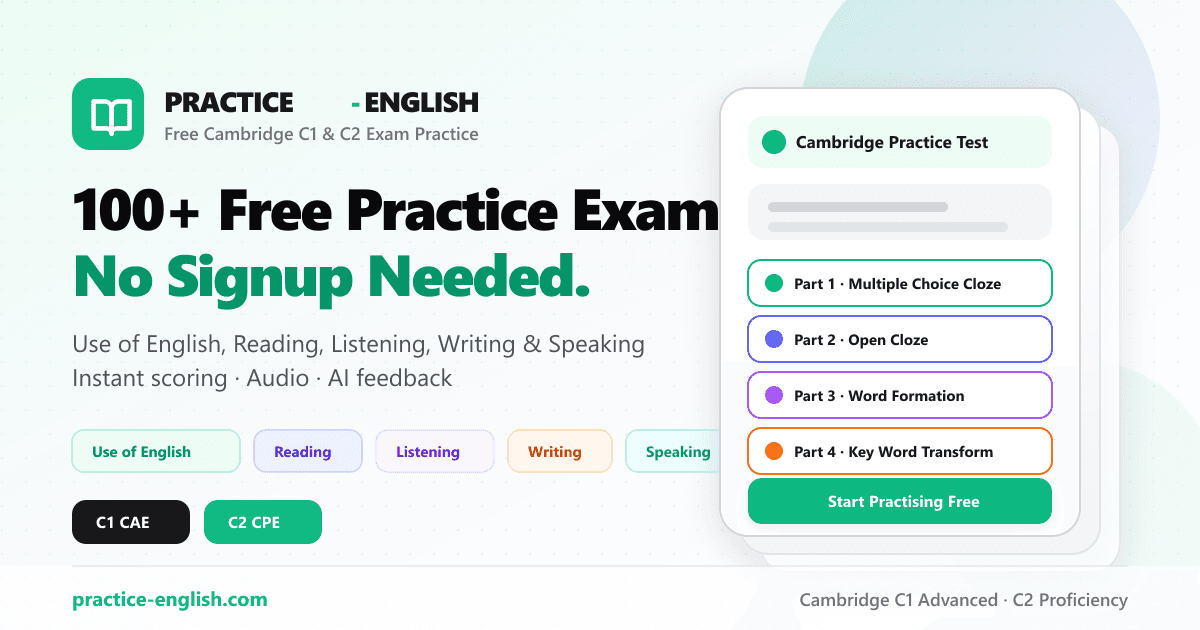
What are the four B2 Use of English parts?
Master B2 First Use of English Parts 1–4 with practical strategies for cloze, word formation, transformations, timing and error review.
Editorial scope and evidence
This guide answers What are the four B2 Use of English parts? It was reviewed on 2026-09-21 against the primary references listed below. Recommendations are educational study guidance; official exam formats, results, and platform features should always be confirmed with the linked provider.
The B2 First Use of English tasks test whether grammar and vocabulary are available quickly enough to use in context. They sit inside the 75-minute Reading and Use of English paper and make up Parts 1–4. Together, these parts reward collocation knowledge, grammatical control, word-building and accurate paraphrase.
The fastest improvement usually comes from treating each part as a different skill. “Do more Use of English” is too broad. A candidate who struggles with collocations needs a different plan from someone who loses marks through transformation word limits.
What are the four B2 Use of English parts?
| Part | Task | Questions | What it mainly tests |
|---|---|---|---|
| 1 | Multiple Choice Cloze | 8 | Collocations, phrasal verbs, lexical choice |
| 2 | Open Cloze | 8 | Grammar and function words |
| 3 | Word Formation | 8 | Word families, prefixes, suffixes |
| 4 | Key Word Transformation | 6 | Paraphrase and grammar control |
Parts 1–3 normally award one mark per correct answer. Part 4 can award up to two marks per item, so careless transformations are expensive.
Train all four parts in the B2 Use of English hub, but keep separate notes for each part.
Part 1: how do you solve Multiple Choice Cloze?
Part 1 gives you four options for each gap. The trap is that several options may have similar dictionary meanings. The question often depends on which word naturally combines with the words around the gap.
Suppose the sentence needs the idea “___ a decision”. Knowing four synonyms for make is less useful than knowing the fixed partnership make a decision. That is why collocations should be learned as chunks rather than isolated words.
Use this order:
- read the whole sentence before looking at options;
- predict the type of phrase that belongs in the gap;
- test each option against the words immediately before and after it;
- check register and meaning across the paragraph;
- reject options that are grammatically possible but collocationally unnatural.
Create vocabulary cards with a gap around the collocation, not a translation alone. For example: take ___ for something → responsibility. Retrieval in context is much closer to the exam task.
Part 2: what actually appears in Open Cloze?
Part 2 has no options. The missing words are usually small grammatical items rather than impressive vocabulary. Common categories include:
- articles;
- auxiliary verbs;
- prepositions;
- relative pronouns;
- conjunctions and linkers;
- parts of fixed grammatical patterns;
- quantifiers and reference words.
Before guessing, ask what grammatical job the gap performs. If the next word is a past participle, perhaps an auxiliary is missing. If the sentence contrasts two ideas, perhaps a linker is needed. If the clause already has a main verb, inserting another lexical verb is unlikely.
A useful drill is to take a completed Open Cloze and cover the answers. For each gap, write only the category first: article, preposition, relative pronoun. Then supply the word. This trains structural prediction rather than random trial and error.
Part 3: how do you master Word Formation?
Part 3 gives a root word and asks you to change it so the sentence becomes grammatically and semantically correct. The obvious challenge is suffixes, but many marks are lost because candidates solve the word class and ignore polarity.
For example, you may correctly decide that a gap needs an adjective but fail to notice that the meaning is negative. The final answer might require a prefix as well as a suffix.
Use a four-question check:
- What part of speech is needed?
- Does the meaning need to be positive or negative?
- Is there an irregular spelling change?
- Does the final word fit the collocation around it?
Build word-family tables from your own errors:
| Root | Noun | Verb | Adjective | Adverb |
|---|---|---|---|---|
| rely | reliance | rely | reliable / unreliable | reliably |
| persuade | persuasion | persuade | persuasive | persuasively |
| compete | competition | compete | competitive | competitively |
Do not memorise enormous generic lists. Prioritise families you have actually failed to produce.
Part 4: what is the best Key Word Transformation method?
B2 Part 4 requires you to rewrite a sentence using a fixed key word without changing the meaning. The answer must stay within the official word limit, and you must not alter the key word.
The efficient method is not to rewrite word by word. First identify the relationship between the sentences. Typical relationships include:
- active ↔ passive;
- direct ↔ reported speech;
- comparatives and superlatives;
- conditionals and wishes;
- modal verbs;
- verb patterns;
- causatives;
- too/enough structures;
- despite/although contrasts;
- phrasal or fixed expressions.
Then build the transformation around that structure. Count the words only after the sentence is grammatically complete.
Keep a transformation notebook organised by structure, not by test number. Six pages such as “conditionals”, “passives”, “reported speech”, “comparisons”, “verb patterns” and “fixed phrases” are much easier to revise than fifty random answers.
How much time should you spend on Parts 1–4?
The whole Reading and Use of English paper lasts 75 minutes, so Use of English cannot consume the entire session. A practical target is roughly 30–35 minutes for Parts 1–4, leaving the remaining time for the longer Reading tasks.
One possible split is:
- Part 1: about 7 minutes;
- Part 2: about 7 minutes;
- Part 3: about 8 minutes;
- Part 4: about 10 minutes;
- quick check before moving on.
These are training targets, not official per-part limits. If Part 4 is your strongest area and Part 2 is slower, adapt. The goal is to prevent one difficult gap from stealing time from several easier questions later.
What should you write in an error log?
Use precise labels. Here are examples:
| Weak note | Better diagnosis |
|---|---|
| “Vocabulary” | Chose synonym but missed verb–noun collocation |
| “Grammar” | Missed auxiliary in present perfect passive |
| “Word formation” | Correct adjective, forgot negative prefix |
| “Transformation” | Correct structure, exceeded word limit |
After logging an error, produce one new example from memory. If you missed despite + noun/-ing, write a fresh sentence using that structure. Production forces you to rebuild the rule rather than simply recognise the corrected answer.
Which grammar topics give the best return for B2?
You do not need to revise every grammar chapter equally. High-value areas include:
- conditionals, including third and mixed patterns;
- passive forms and causatives;
- modal verbs of deduction and obligation;
- reported speech and reporting verbs;
- relative clauses;
- gerund and infinitive patterns;
- comparisons;
- contrast linkers;
- present perfect vs past forms;
- dependent prepositions.
Use B2 Grammar practice to repair specific structures after your error log identifies them. Grammar revision is most efficient when it answers a real problem from an exam task.
How should vocabulary be studied for Use of English?
Focus on relationships between words. A useful B2 vocabulary entry includes:
- the word or phrase;
- one common collocation;
- a dependent preposition if relevant;
- one example sentence;
- one contrast with a commonly confused word;
- the word family if productive.
For example, learning responsible is much weaker than learning responsible for, take responsibility for, a responsible decision and irresponsible. That network can help in Parts 1, 2 and 3, and later in Writing and Speaking.
What are the most common preparation mistakes?
Repeating full tests without repairing errors. You see new questions but preserve old weaknesses.
Learning rare vocabulary before common collocations. B2 rewards accurate, natural combinations more than decorative obscurity.
Ignoring spelling. Open responses can lose marks even when your grammatical idea was correct.
Treating Part 4 as translation. Transformations test English-to-English paraphrase, not translation from your first language.
Studying grammar only through explanations. Recognition is easier than production. You need to create sentences and transformations yourself.
A two-week Use of English repair plan
Days 1–3
Complete one set from each part and classify every mistake. Do not chase volume.
Days 4–6
Study only the two most frequent error categories. Build examples and short drills.
Day 7
Retest those parts with fresh material under time pressure.
Days 8–10
Add mixed practice so you must identify the structure without being told which rule is being tested.
Days 11–13
Run Parts 1–4 together in about 30–35 minutes. Review spelling and transformation limits.
Day 14
Compare the new error log with Day 1. Improvement means repeated error types are disappearing, not simply that one percentage is higher.
Final takeaway
B2 Use of English becomes much more manageable when you stop treating it as one subject. Part 1 is lexical fit, Part 2 is grammatical structure, Part 3 is word-building and Part 4 is controlled paraphrase. Diagnose at that level, repair the exact pattern, and then retest it under time pressure.
Next step
Ready to practise?
Apply this strategy with free tasks, guided review, and exam-focused feedback on Practice English.
Practise B2 Use of EnglishWhich official sources inform this B2 guide?
- Cambridge University Press & Assessment: B2 First exam overview and format — retrieved 2026-09-21
- Cambridge University Press & Assessment: Cambridge English Scale — retrieved 2026-09-21
- Council of Europe: Common European Framework of Reference for Languages — retrieved 2026-09-21