Is C2 Proficiency
Worth It?
C2 costs time, money, and nerve. Here is when the lifelong certificate pays off — and when C1 Advanced or IELTS is the smarter move.
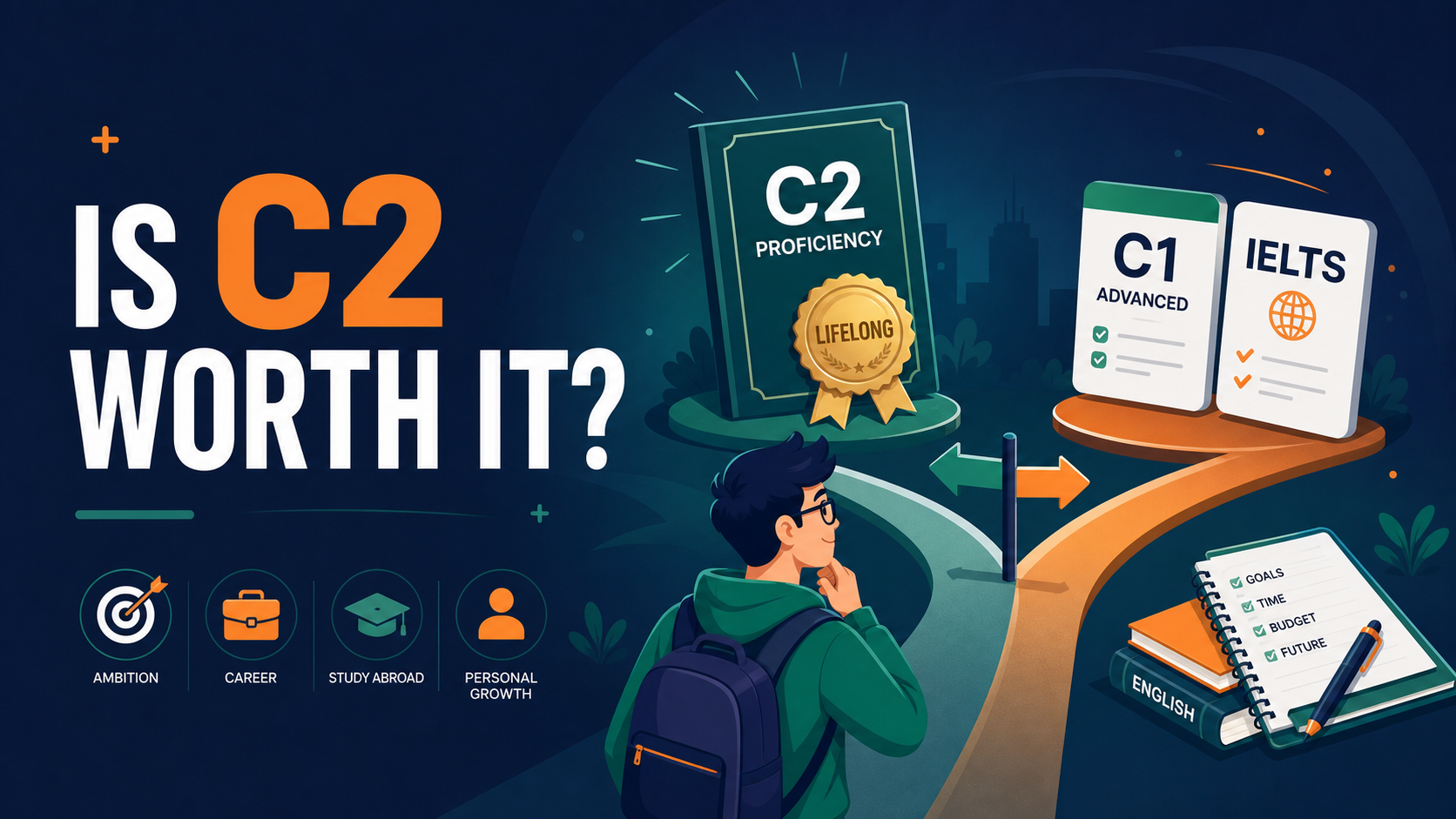
Is Cambridge C2 Proficiency worth it?
In 2026, C2 is worth it if you need permanent proof of elite English — top universities, competitive careers, or personal mastery. With 70–75% pass rates and no certificate expiry, it beats IELTS for long-term credential value. If you only need a 6.5 IELTS for one application, C1 or IELTS is usually faster.
Is C2 Proficiency worth it? It is the question every ambitious English learner asks eventually — usually at 11 p.m., after scrolling university requirements, comparing exam fees, and wondering whether the highest Cambridge qualification is a career accelerant or an expensive vanity project.
The honest answer is neither universal yes nor dismissive no. C2 Proficiency is worth it for specific people, at specific career stages, with specific goals. It is not worth it for candidates who need a quick B2 stamp, a single visa deadline, or proof of conversational fluency alone.
This guide analyses university admissions, career signalling, real costs, immigration realities, certificate expiry economics, and return on investment — so you can decide with data, not hype.
Is C2 Proficiency Worth the Investment in 2026?
In 2026, C2 Proficiency remains the highest mainstream English credential with no expiry date and global recognition among elite institutions. That combination is rare. IELTS and TOEFL dominate volume, but their two-year validity windows force periodic retakes for anyone whose career spans decades.
C2 is worth the investment when:
- You need permanent proof of near-native English for a multi-decade career (academia, diplomacy, publishing, senior multinational roles).
- Your target institution or employer explicitly values Cambridge qualifications at C2 level — or treats C2 as a distinguishing signal above C1 or IELTS 7.5.
- You have already invested years reaching strong C1 and want the summit credential for personal or professional closure.
- You teach English or work in language-intensive fields where prestige and precision matter on a CV.
C2 is a poor investment when:
- You need only IELTS 6.5 or TOEFL 90 for one application due in three months.
- Your employer accepts B2 or C1 and will never distinguish C2 from CAE.
- You have never sat a Cambridge exam and underestimate the Use of English paper.
Global pass rates sit around 70–75%, with only 10–13% achieving Grade A. The exam is selective by design. The investment is not merely the exam fee — it is six to eighteen months of preparation time, opportunity cost, and psychological stamina.
If you are still mapping what C2 actually is, start with What is Cambridge C2 Proficiency? before committing emotionally or financially.
What University Admissions Officers Think About CPE
University requirements vary more than Cambridge marketing suggests. Most undergraduate and taught master's programmes in the UK accept C1 Advanced, IELTS 6.5–7.5, or equivalent — not C2 specifically.
Where C2 shines:
- Competitive programmes where English ability signals intellectual seriousness — law, international relations, literature, linguistics, translation studies.
- European universities (Germany, Switzerland, Austria, Scandinavia) with long-standing Cambridge recognition traditions.
- PhD applications where a lifelong C2 certificate accompanies decades of research output — no retake before your viva.
- Scholarship panels scanning hundreds of applications; Cambridge C2 Proficiency, Grade A is a memorable differentiator.
Where C2 is unnecessary:
- Programmes listing IELTS 6.5 or C1 Advanced as minimum — exceeding requirements rarely changes admission odds.
- US institutions defaulting to TOEFL iBT; C2 may be accepted but is rarely preferred.
- Courses where subject grades dominate and English is a checkbox.
Practical advice: Search your exact programme page. If it says "IELTS 7.0 or equivalent," check the equivalency table. C1 Advanced Grade B often suffices. C2 is insurance — not always advantage.
Compare the Cambridge ladder in our C2 vs C1 Advanced comparison if you are torn between exams — the next article in this FAQ series.
How Does C2 Boost Your Career Prospects?
On a CV, language credentials communicate more than a bullet point. They signal discipline, international orientation, and assessed precision.
Sectors where C2 carries visible weight:
| Sector | Why C2 matters |
|---|---|
| Diplomacy & international organisations | Permanent proof of elite English without expiry anxiety |
| Publishing & media | Editorial roles demand register control C2 explicitly tests |
| Law (international firms) | Client-facing credibility in English-speaking jurisdictions |
| Academia | Lecturing, peer review, and grant writing at near-native standard |
| Senior management (multinationals) | Board-level communication; credential outlasts job changes |
| English language teaching | Career progression and visa applications in regulated markets |
Sectors where C2 adds little:
- Domestic roles in non-English-speaking markets where B2 suffices.
- Tech roles listing "fluent English" without specification — interview performance trumps certificates.
- Entry-level positions where any upper-intermediate proof is adequate.
C2 is a prestige signal, not a salary guarantee. Employers who recognise it tend to value what it represents: sustained effort, exam composure, and lexical depth. Those who do not recognise it will not Google "CPE" during a six-second CV scan.
What Does C2 Proficiency Actually Cost?
Cost-benefit analysis requires honest accounting — not just the exam fee.
Direct costs
| Item | Typical range (2026) |
|---|---|
| Exam fee | £150–£250 (UK); €200–€350 (continental Europe); varies globally |
| Coursebooks & materials | £50–£150 |
| Private tutoring | £30–£80/hour × 20–40 sessions (optional but common) |
| Retake fee | Full exam fee again if you miss C2 threshold |
Indirect costs
- Preparation time: 200–600 hours over six to eighteen months.
- Opportunity cost: Hours diverted from other study, work, or leisure.
- Travel to exam centre: Speaking on a separate day may mean two trips.
Comparison frame
IELTS Academic costs roughly £175–£200 in the UK with 2–6 months typical preparation. C2 often costs similar exam fees but double or triple preparation time. The ROI calculation therefore hinges on longevity: one C2 pass versus IELTS retakes every decade.
Before paying fees, stress-test readiness with free timed practice — our guide on free C2 practice tests: online vs PDF explains why interactive scoring beats static worksheets for diagnostic value.
When Is C2 Proficiency NOT Worth It?
Intellectual honesty protects your wallet and morale. Skip or defer C2 if:
- Your goal has a nearer alternative. Need IELTS 7.0 for a September intake? Take IELTS. Need C1 for an employer? Take C1 Advanced.
- You have never passed a Cambridge exam. Jumping to C2 without CAE experience is possible but statistically harder. The format shock alone defeats fluent speakers.
- Your weakest skill is Use of English. Conversational excellence does not predict Part 4 transformation success. If mock UoE scores sit below fifty percent, you are months away — not weeks.
- You need results in under three months. C2 is not a cram exam.
- Your industry ignores certificates. If nobody in your hiring chain has heard of CPE, invest in portfolio and interview skills instead.
- You are pursuing C2 for vague "someday" prestige without a concrete use case. Motivation collapses during month nine of collocation drills.
There is no shame in choosing C1 Advanced or IELTS. Strategic exam selection is intelligence, not compromise.
How Does Certificate Expiry Affect ROI?
This is C2's strongest economic argument. Cambridge C2 Proficiency certificates do not expire. IELTS and TOEFL results are typically valid for two years at most institutions. The next article in this FAQ series covers verification, employer policies, and when IELTS still wins despite permanence.
Scenario: You pass IELTS 8.0 at age 28 for a master's application. At 35, you apply for a PhD fellowship requiring recent English proof. You retake IELTS (£200, six weeks prep, exam-day stress). At 42, a UN consultancy role requests English evidence. You retake again.
Same candidate with C2 at 28: One preparation cycle, one exam fee, one certificate — valid at 35, 42, and 55.
NPV framing (simplified):
| Credential | Upfront cost | Recurring cost (20-year horizon) | Total estimated |
|---|---|---|---|
| C2 Proficiency | £200 fee + 400 prep hours | £0 renewal | £200 + time |
| IELTS 8.0 | £190 fee + 150 prep hours | £190 × 3 retakes ≈ £570 | £760 + time |
Time is the larger variable. C2 demands more hours upfront; IELTS may demand repeated hours across a career. For long-horizon careers, C2's no-expiry clause often wins. For single-application sprints, IELTS wins decisively.
Cross-examine format trade-offs in C2 Proficiency vs IELTS and TOEFL.
Is C2 Better Than IELTS for Immigration?
Immigration is country-specific — generalisations mislead.
Canada (Express Entry): Points-based systems prioritise IELTS General Training or CELPIP. C2 is not a standard pathway. IELTS wins.
Australia: Skilled migration uses IELTS, PTE, TOEFL iBT, OET. Cambridge C2 is not typically listed for points. IELTS/PTE win.
UK: Student and work visas specify SELT providers (IELTS UKVI, PTE UKVI, etc.). Standard C2 Proficiency may not satisfy visa English requirements unless taken at an approved SELT centre in the correct format. Check gov.uk guidance meticulously.
EU countries: Some national visa routes accept Cambridge qualifications where listed. C2's lifetime validity helps residence and citizenship applications that accept it — no panic retake before a deadline.
Bottom line: For immigration points, IELTS or PTE is usually correct. For professional registration or employer sponsorship where Cambridge is explicitly accepted, C2's permanence is advantageous.
What Is the Real Return on Investment?
ROI is not purely financial. Quantify three dimensions:
1. Credential durability (high for C2)
A lifelong certificate amortises one preparation cycle across an entire career. This is C2's clearest quantitative advantage.
2. Opportunity access (variable)
If your target door requires or prefers C2, ROI is binary: without it, you do not enter. If the door accepts C1, C2's marginal access benefit is zero.
3. Skill development (high but double-edged)
C2 preparation genuinely improves lexical range, writing precision, and listening stamina. Even "failed" candidates often emerge stronger. However, those skills could be developed without sitting the exam — the credential is the priced bundle.
4. Signalling and self-concept (subjective)
For some candidates, C2 is a personal milestone — proof against impostor syndrome in English-dominated environments. That psychological ROI is real but non-transferable on a balance sheet.
Grade sensitivity: Grade A (220+) signals exceptional performance; Grade C (200–212) certifies C2 at minimum threshold. Employers rarely distinguish, but you will know.
Model whether your mock paper scores support a pass — or a costly narrow miss — with the C2 score calculator before booking.
How Do You Know If You Are Ready?
Practical readiness indicators:
| Indicator | Ready signal | Not ready signal |
|---|---|---|
| C1 Advanced result | Grade A or strong B (190+) | Grade C at minimum threshold |
| Use of English mocks | 60%+ across Parts 1–4 | Below 50% on Parts 3–4 |
| Writing | Timed essays within word limits, minimal register errors | Consistent under-length or off-genre tasks |
| Listening | 28+/31 on recent past papers | Below 24/31 consistently |
| Speaking | Sustained two-minute long turns without collapse | Heavy filler, limited range under pressure |
If three or more "not ready" signals appear, delay booking. Exam fees are cheaper than regret.
Do not rely on a single mock. Look for stable performance across several timed attempts, especially in Use of English, before deciding that you are ready to book the exam.
Summary: When C2 Pays Off — and When It Does Not
| Situation | Verdict |
|---|---|
| Lifelong academic career in English | Worth it |
| Senior international role; Cambridge recognised | Worth it |
| Personal mastery goal; time available | Worth it |
| Single UK/EU master's; C1/IELTS sufficient | Probably not |
| Canada/Australia immigration points | No — use IELTS/PTE |
| Under six months preparation window | No — defer |
| Strong speaking, weak UoE | Not yet — train first |
C2 Proficiency is worth it when you value permanent, prestigious proof of the highest standard English examination offers — and when your timeline tolerates serious preparation. It is not worth it when a faster, cheaper, purpose-built exam (IELTS, TOEFL, C1 Advanced) satisfies the same gatekeeper.
Choose the exam that matches the door you are opening. C2 is the master key only where the lock demands it — and for careers measured in decades, that is often more doors than you expect.
Which Sources Inform This Analysis?
- Cambridge University Press & Assessment: C2 Proficiency exam overview — retrieved 2026-06-12
- Cambridge University Press & Assessment: Cambridge English Scale — retrieved 2026-06-12
- IELTS: IELTS Academic overview — retrieved 2026-06-12
- ETS: TOEFL iBT overview — retrieved 2026-06-12