Advanced relative reference
A relative clause can point to a person or thing, but it can also comment on a whole idea. At C2, the challenge is often not choosing a relative word from memory; it is making its reference unmistakable. Ask yourself: what exactly does this clause refer back to?
When the whole previous idea is the antecedent
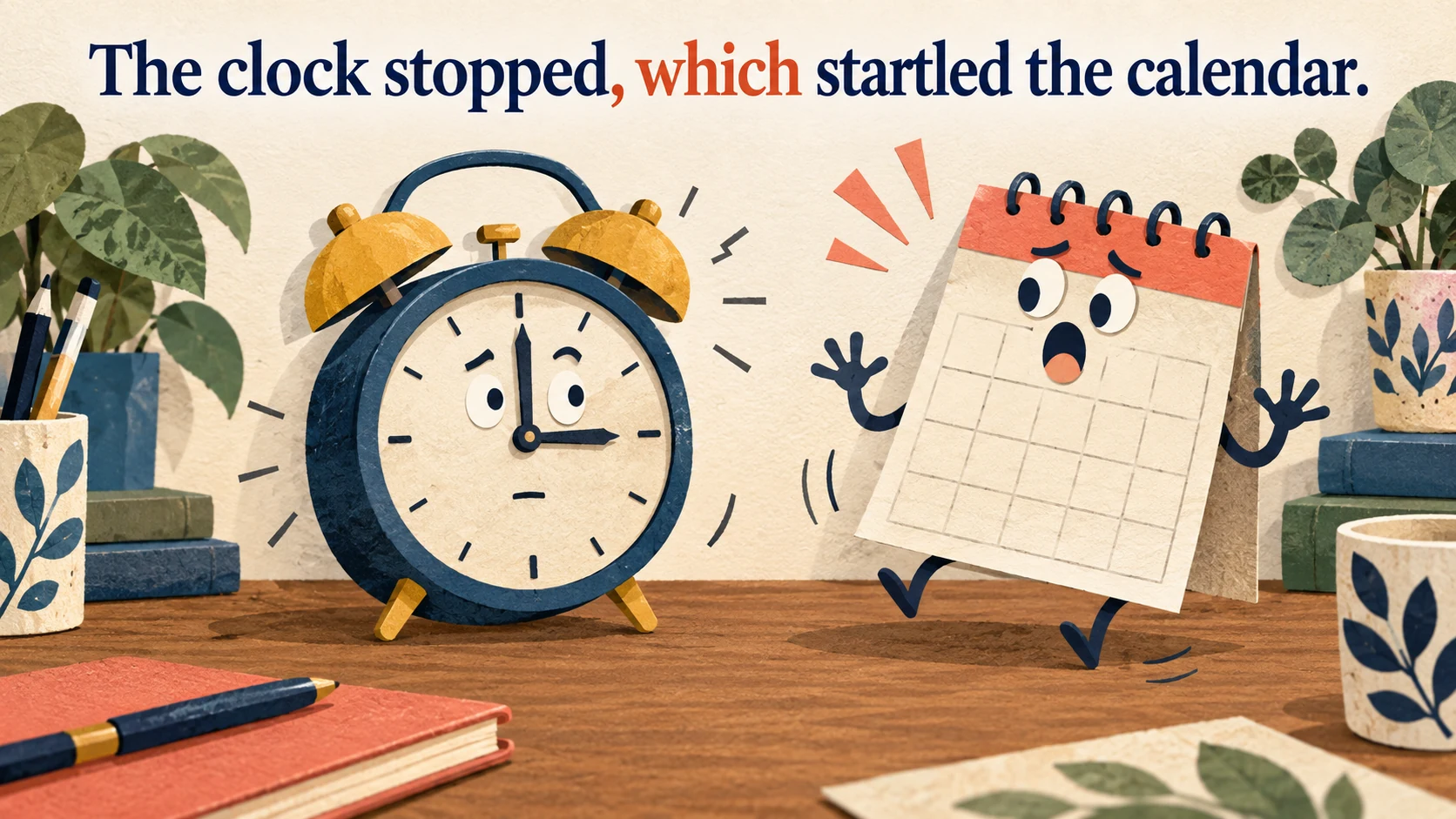
Use a comma and which to comment on an entire preceding clause or event:
The committee postponed the vote, which surprised the observers.
Which refers to the postponement. It does not refer only to vote. The comma signals that the clause adds a comment rather than identifying which vote we mean.
Do not use that for this sentential reference:
Incorrect: The committee postponed the vote, that surprised the observers.
Correct: The committee postponed the vote, which surprised the observers.
If the previous sentence contains several possible events, name the idea instead of relying on a vague this or which:
The committee postponed the vote after the chair resigned. This decision surprised observers.
Clearer: The postponement surprised observers.
Make the relative clause fit its noun
In formal writing, a preposition can come before whom or which:
the consultant to whom I spoke
the conditions under which the licence may be renewed
The preposition belongs with the verb or adjective: speak to someone; operate under conditions. In everyday English it often stays at the end, and that version is grammatical too:
the consultant who I spoke to
After a fronted preposition, use whom for a person and which for a thing. Do not put that after a preposition.
Quantifier phrases can point back to a plural group:
The proposal attracted twelve responses, most of which raised the same concern.
Four researchers joined the review, two of whom had worked on the original trial.
Use of whom for people and of which for things. The quantifier phrase is not a complete relative clause by itself; it needs the relative word and the preposition.
Keep restrictive and supplementary information distinct
A defining relative clause identifies the noun and normally has no commas:
The files that were encrypted could not be opened.
This means only the encrypted files could not be opened. A non-defining clause adds information about a noun already identified:
The files, which were encrypted, could not be opened.
This says all the files were encrypted. The commas change the scope, and therefore the meaning.
Common mistakes
- The plan was rejected, that surprised us. Use which for a comment on the whole event.
- the person to who I spoke → the person to whom I spoke in formal preposition-fronted style.
- The policy, that applies to contractors, ... Use which in a non-defining clause.
- The report and the appendix were revised, which was circulated yesterday. Which may have unclear scope. Write both of which were circulated yesterday if both documents were circulated.
Quick check
What does the relative phrase refer to?
- The board withdrew the recommendation, which had been issued only the previous week.
- Three proposals were submitted, none of which addressed the cost of implementation.
- The director whom we interviewed later withdrew the claim.
Answers:
- Which comments on the withdrawal or recommendation? The grammar makes it most naturally describe the recommendation; if you mean the withdrawal, write The board withdrew the recommendation, a decision made only the previous week or name the event directly.
- Which refers to the proposals; none of which means not one of those proposals.
- Whom is the object of interviewed. A less formal order, who we interviewed, is also possible.
Make the reference unmistakable
A relative word is useful only when the reader can identify its antecedent immediately. Try replacing which with a noun phrase. If two different nouns or events make sense, the sentence needs a clearer reference.
The laboratory changed the protocol after the first trial, which affected the results.
Did the change affect the results, or did the first trial? The grammar alone may not settle the question. Name the intended event:
The laboratory changed the protocol after the first trial. This change affected the results.
A sentence-initial This can also be vague. In formal prose, a short noun such as decision, delay, finding or departure tells the reader exactly what is being summarised. Repeat a key noun when repetition is clearer than ambiguity.
Restrictive or supplementary: decide what the reader needs to identify
A defining relative clause helps identify a person or thing from a larger group. A supplementary clause comments on an already identified person or thing. Compare:
The reviewers who had declared a conflict left the room.
The reviewers, who had declared a conflict, left the room.
Without commas, only the conflict-declaring reviewers left; the sentence leaves open whether other reviewers stayed. With commas, the clause presents the declaration as background information about all the reviewers. Punctuation is part of the meaning, not merely a pause.
A non-defining clause cannot normally begin with that. A defining clause may use that for people or things in many contexts, but after a fronted preposition the relative form must be whom or which:
the colleague with whom I worked
the criteria on which the decision was based
The less formal alternatives put the preposition at the end: the colleague who I worked with; the criteria which the decision was based on. Choose one pattern and keep the clause complete.
Quantifier + of + relative pronoun
Use all / both / some / none / many / most / one / two + of whom/which when the relative clause refers to members of a named group:
The two reports, both of which were independently reviewed, reached the same conclusion.
Six witnesses were interviewed, three of whom had been present at the meeting.
The noun before the comma supplies the group. Use whom for people and which for things. Avoid three of them if you intend a relative clause attached to the previous noun.
Guided practice
- Join the sentences without making the reference vague: The editor removed the final paragraph. This surprised the author.
- Add commas if the relative clause describes all members: The two applicants who had overseas experience were offered interviews.
- Complete formally: The committee interviewed five consultants, two ___ had worked on the original project.
Answers and reasoning
- The editor’s decision to remove the final paragraph surprised the author. Naming the event removes doubt about what surprised the author.
- If both applicants had overseas experience, write The two applicants, who had overseas experience, were offered interviews. Without commas, the clause identifies which applicants.
- of whom. The antecedent is people, so use whom.
Preposition placement signals register
A relative preposition can stay at the end of its clause or move before the relative pronoun:
the policy which the decision depends on
the policy on which the decision depends
The first is natural in conversation and ordinary prose. The second is more formal and is especially useful in carefully edited academic or professional writing. Once the preposition is fronted, use whom for a person or which for a thing; do not use that or omit the relative word:
the specialist to whom the team appealed
the principles on which the method is based
The preposition is determined by the relationship inside the clause: appeal to a specialist; base a method on principles. Keep it with the relative phrase it belongs to.
Which can point to an entire proposition
When which comments on a whole clause, put a comma before it:
The laboratory changed the protocol, which delayed the publication.
That pattern is useful, but not always precise if the previous sentence has several events. Replace a vague which with a noun that names the intended event: This revision delayed publication. Use which after a comma for a supplementary comment, not that.
Further reading
Try this structure in a short practice set with instant feedback.
Start practice