Advanced clefts and reversed pseudo-clefts
Advanced clefts and reversed pseudo-clefts
Clefts divide a message into two parts so that one detail can take the focus.
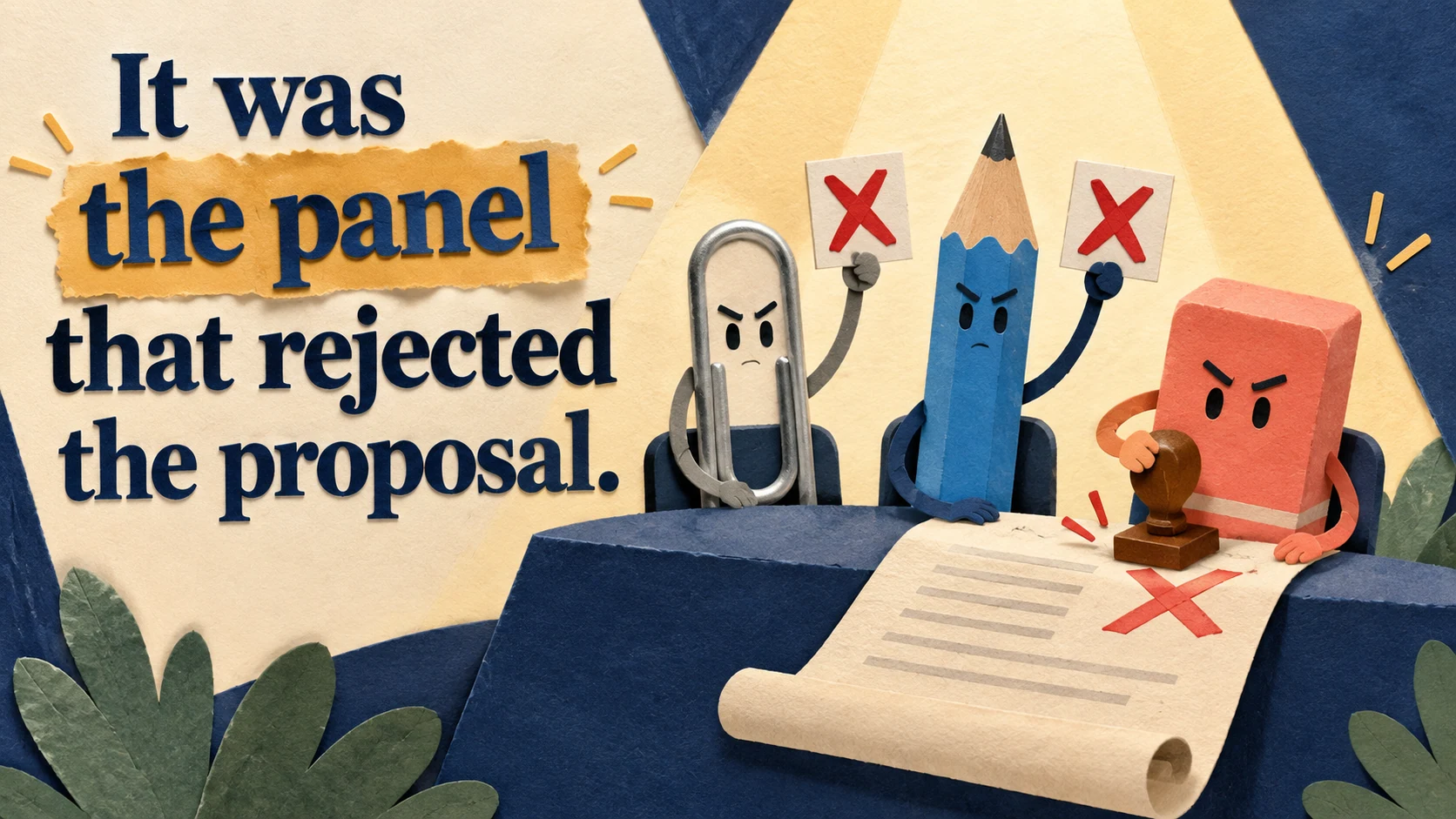
A sentence can describe an event while giving different information special prominence:
The panel rejected the proposal on Tuesday.
It was the panel that rejected the proposal on Tuesday.
It was the proposal that the panel rejected on Tuesday.
It was on Tuesday that the panel rejected the proposal.
The event stays the same, but the focus changes. The first cleft answers Who rejected it? The second answers What did the panel reject? The third answers When did it happen?
A cleft divides one message into two parts: the information in focus and the rest of the message. It is useful when you need to correct an assumption, make a contrast or guide the reader towards a particular detail. Cambridge describes clefts as a way to foreground new information against background information (Cambridge: “Cleft sentences”); BBC Learning English demonstrates how changing the focus changes the point of an it-cleft (BBC Learning English: “Giving emphasis, Part 1”).
What you will learn
By the end of this lesson, you will be able to:
- use it-clefts to focus on a person, thing, time, place or reason;
- use what-clefts to present an action, fact or need before giving its focus;
- form reversed pseudo-clefts with the focus at the beginning;
- keep agreement and verb patterns accurate inside the clauses; and
- choose a cleft that fits the information your reader needs.
1. It-clefts: It + be + focus + clause
The basic pattern is:
It + be + focused element + who/that + the rest of the message
The focused element answers an implied question.
| Implied question | It-cleft |
|---|---|
| Who rejected the proposal? | It was the panel that rejected the proposal. |
| What did the panel reject? | It was the proposal that the panel rejected. |
| When did the panel reject it? | It was on Tuesday that the panel rejected the proposal. |
| Where did the panel meet? | It was in the archive that the panel met. |
| Why was the vote delayed? | It was because a document was missing that the vote was delayed. |
For a person, who is a clear choice:
It was the external reviewer who noticed the discrepancy.
That is also commonly used for people in this pattern. Use that for things and for many time, place and reason phrases:
It was the missing document that delayed the vote.
It was after the second review that the panel changed its recommendation.
The clause after the focus still needs its own grammar
The phrase after who or that connects the focus to the rest of the message. The focused element has a role in that clause.
When the focus is the subject, the clause has a subject gap:
It was the external reviewer who noticed the discrepancy.
The reviewer noticed the discrepancy.
When the focus is the object, there is an object gap:
It was the discrepancy that the reviewer noticed.
The reviewer noticed the discrepancy.
Do not repeat the object with a pronoun in careful written English:
Not: It was the discrepancy that the reviewer noticed it.
It was the discrepancy that the reviewer noticed.
In less formal speech, that or who can sometimes be left out when the focused element is the object: It was the discrepancy the reviewer noticed. In careful writing, keeping the connector usually makes the structure easier to follow.
Tense and agreement in it-clefts
The opening it + be is singular, while the verb in the following clause agrees with the subject it has there:
It is the final two chapters that explain the change.
Is belongs to the opening it clause. Explain agrees with the final two chapters. Cambridge gives this same distinction for plural subjects in it-clefts (Cambridge: “Cleft sentences”).
Choose is or was according to how you present the identification. The tense in the following clause reflects the event itself:
It was on Monday that the archive reopened.
It is the final paragraph that explains the change.
2. What-clefts: What + clause + be + focus
A what-cleft starts with a clause that means roughly the thing that, the action that or the fact that:
What the panel needs is a clearer definition of the sample.
What surprised the editor was the source of the quotation.
What matters most is whether the claim can be reproduced.
The opening what-clause sets up an idea, question or need. The phrase after be supplies the focus.
A what-cleft can also focus an action:
What the team did was repeat the test.
After a what-clause containing do, a bare verb is common: was repeat. A to-infinitive is also possible in many contexts: was to repeat.
A what-clause is not a direct question
Compare the direct question:
What did the report omit?
with the what-cleft:
What the report omitted was the publication date.
The what-clause in the cleft uses normal statement order: the report omitted, not did the report omit. It does not take a question mark.
3. Reversed pseudo-clefts: put the answer first
A reversed pseudo-cleft puts the focus before be and the what-clause after it:
A clearer definition of the sample is what the panel needs.
The source of the quotation was what surprised the editor.
Two independent measurements are what the team requires.
This gives the reader the answer or topic first, then uses the what-clause to explain or identify its connection to the message. It can be useful when the opening phrase links naturally to the previous sentence:
The reviewers have agreed on the main weakness. A clearer definition of the sample is what they need.
The what-clause still uses statement word order. The whole sentence is a statement, even though it contains what.
What about is or are in a what-cleft?
With a singular focus, use the singular form:
What the reviewers need is a clearer definition.
What surprised us was the timing of the announcement.
When the focus is clearly plural, plural agreement is also used:
What the reviewers need are two independent measurements.
Agreement in what-clefts can follow either the what-clause as a whole or a clearly plural focus. BBC Learning English illustrates both patterns (BBC Learning English: “Subject-Verb Agreement 3”). If the choice feels awkward in a formal sentence, rephrase it:
The reviewers need two independent measurements.
In a reversed pseudo-cleft, the verb agrees with the opening noun phrase:
A measurement is what the reviewers need.
Two measurements are what the reviewers need.
4. Choosing among the three patterns
The same underlying message can be presented in all three ways:
The absence of a control group weakened the conclusion.
It-cleft — focus on one specific element
It was the absence of a control group that weakened the conclusion.
What-cleft — present the issue, then identify it
What weakened the conclusion was the absence of a control group.
Reversed pseudo-cleft — name the focus first
The absence of a control group was what weakened the conclusion.
Choose the version that best fits the context:
- Use an it-cleft when one constituent answers the question that matters: Who? What? When? Where? Why?
- Use a what-cleft when the action, need or issue provides a useful starting point: What the team needs is…
- Use a reversed pseudo-cleft when the answer or topic belongs naturally at the beginning: A second review is what the team needs.
A cleft usually works best when its background clause connects to information the reader can already follow. If it introduces a focus without a clear reason, it can sound as if it is correcting a claim nobody made.
5. Contrast and correction
Clefts are especially useful when you need to distinguish between two possible explanations or correct a misunderstanding:
It was not the sample size but the absence of a control group that weakened the conclusion.
Keep the alternatives parallel. Here, the sentence contrasts two possible causes. A less balanced comparison can make the reader pause to work out what is being compared.
Clefts and passives can both change what comes first, but they do different jobs:
The panel rejected the proposal. — a neutral statement of the event
It was the panel that rejected the proposal. — focus on who rejected it
The proposal was rejected by the panel. — the proposal is the grammatical subject
Use a cleft to identify a focus. Use a passive when the affected person or thing is the natural subject, or when the agent is unknown or less important.
6. Common mistakes
Adding it after a what-clause
Not: What mattered it was the timing.
What mattered was the timing.
The what-clause already fills the opening subject position.
Combining two focus patterns
Not: It was because the costs were high why the project stopped.
It was because the costs were high that the project stopped.
Use that with this reason-focused it-cleft. A different structure is What I do not understand is why the project stopped.
Forgetting agreement inside an it-cleft
Not: It was the final two chapters that explains the change.
It was the final two chapters that explain the change.
Explain agrees with the final two chapters.
Repeating an object pronoun
Not: It was the conclusion that the reviewers challenged it.
It was the conclusion that the reviewers challenged.
The focused phrase is understood as the object of challenged.
Using question order inside a what-cleft
Not: What did the inquiry discover was a missing signature.
What the inquiry discovered was a missing signature.
The what-clause uses statement order, not question order.
Adding a cleft when ordinary order is clearer
It was the final report that showed the discrepancy.
The final report showed the discrepancy.
The first version highlights the final report. If there is no contrast or focus to signal, the second is simpler.
7. Guided practice
Rewrite or analyse each sentence.
- Focus on the person: The external reviewer noticed the discrepancy.
- Focus on the object: The editor removed the final paragraph.
- Make a what-cleft: The team needs to repeat the test.
- Make a reversed pseudo-cleft: The team needs a clearer definition.
- Correct the sentence: It was because one signature was missing why publication was delayed.
- Correct the word order: What did the review establish was that the figures had been altered.
Answers and reasoning
- It was the external reviewer who noticed the discrepancy. The focus is the subject of noticed.
- It was the final paragraph that the editor removed. The focus is the object of removed; do not add another object pronoun.
- What the team needs to do is repeat the test. The what-clause sets up the need; the infinitive supplies the action.
- A clearer definition is what the team needs. The answer comes first, followed by the identifying what-clause.
- It was because one signature was missing that publication was delayed. Use that to complete this reason-focused it-cleft.
- What the review established was that the figures had been altered. The what-clause uses statement order, not question order.
Further reading
- Cambridge Dictionary: “Cleft sentences” — it-clefts, wh-clefts, focus and agreement.
- BBC Learning English: “Giving emphasis, Part 1” — how an it-cleft changes the focus of a message.
- BBC Learning English: “Subject-Verb Agreement 3” — singular and plural agreement in cleft sentences.
Try this structure in a short practice set with instant feedback.
Start practice