Conditional alternatives and implied conditions
An if-clause is only one way to make a condition. In formal discussion, the condition may be compressed into a noun phrase, attached to the previous sentence with otherwise, or introduced by a word such as provided. To understand these forms, first identify the hidden relationship: what must be true for the result to happen?
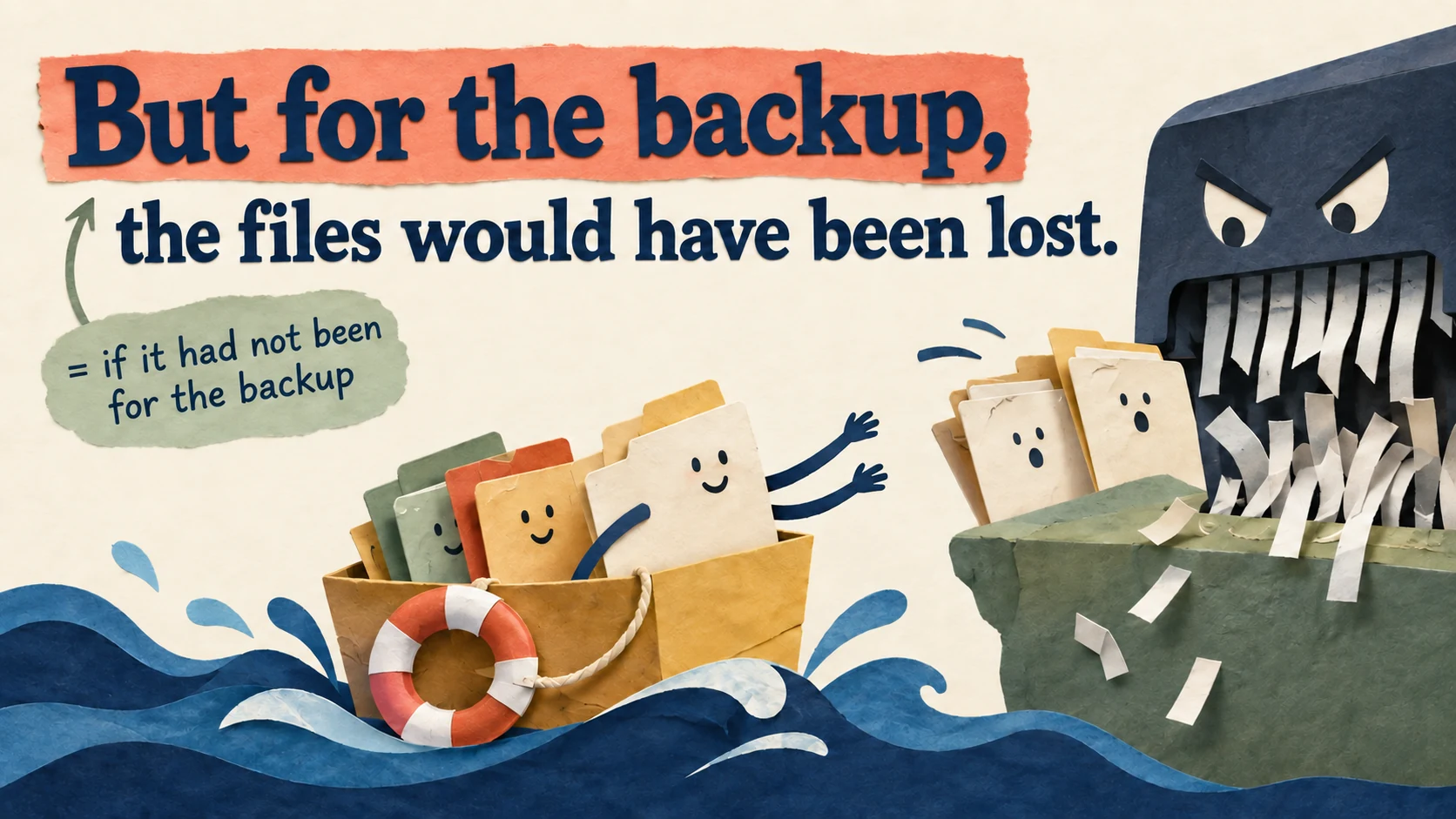
But for and without
But for + noun phrase means if it were not for / if it had not been for. The following clause tells us what would happen without that person or thing:
But for the archivist’s careful notes, the provenance of the letters would remain uncertain.
Without an independent test, the result might have gone unnoticed.
Use would / could / might in the result when describing an unreal or imagined alternative. The tense depends on the time reference:
But for the emergency grant, the project would have closed last year.
But for the emergency grant, the project would close this year.
The first sentence looks back at a past situation that did not happen; the second imagines a present or future alternative.
Otherwise: carry the condition forward
Otherwise means if not or if that does not happen. It points back to a proposal, instruction or fact in the preceding clause:
Submit the revised copy by noon; otherwise, it may miss the review window.
Here the condition is “if you do not submit it by noon”. Make the reference clear: when a sentence contains several possible actions, otherwise may not tell the reader which one is meant.
Or else has a similar conditional meaning but can sound more forceful or threatening:
Keep a copy of the receipt, or else you may have no proof of payment.
Provided, as long as and supposing
Provided / providing (that) and as long as introduce a condition that must be met:
The quotation may be used, provided that its source is acknowledged.
You can appeal as long as you do so within thirty days.
For a future condition, use a present form in the condition clause, not will:
Provided that the panel agrees, the revised terms will take effect next month.
Supposing / assuming invites the reader to consider an imagined case:
Supposing the figures were accurate, would the conclusion still follow?
It does not assert that the figures are accurate. It opens a line of reasoning.
Three structures to keep apart
- if states the condition directly.
- in case explains a precaution taken because something may happen: Take a copy in case the system fails.
- otherwise refers back to a condition already stated: Save a copy; otherwise, the changes may be lost.
Common mistakes
- But for you helped us, we would have failed. Use a noun phrase after but for: But for your help...
- Provided costs will remain stable, we will proceed. Use present simple in the condition: provided costs remain stable.
- Keep a copy in case the system fails; otherwise the system may fail. Here otherwise does not connect logically to the precaution. Write ...; otherwise, your changes may be lost.
- Supposing if the evidence were incomplete... Do not combine two conditional openings.
Quick check
Choose a structure and explain the hidden condition.
- Save the receipt; ______ you may be unable to claim reimbursement.
- ______ a technical fault, the data would have been irretrievable.
- The permit will be renewed, ______ the inspection finds no safety breach.
Answers: otherwise (if you do not save the receipt); But for (if there had been no backup); provided that / providing (renewal depends on the inspection result).
Map the hidden condition
Many conditional expressions are easier to use when you first expand them into an if-clause. This reveals what the sentence assumes and whether the result concerns the present, future or an unreal past.
| Compact expression | Hidden meaning | Example |
|---|---|---|
| but for + noun phrase | if it were not for / had not been for | But for the backup, the files would have been lost. |
| otherwise | if not / if that does not happen | Save a local copy; otherwise, your edits may be lost. |
| provided (that) / as long as | on the condition that | The quotation may be used, provided its source is named. |
| supposing / assuming (that) | imagine this condition for the sake of argument | Supposing the estimate were accurate, would the plan still be affordable? |
| in case | take a precaution because something may happen | Keep a paper copy in case the network fails. |
The phrases are not interchangeable. Otherwise points backwards to a condition already stated. In case gives the reason for a precaution, not the result of failing to take it. Compare: Take a copy in case the server fails; otherwise, the team may have no record. The first tells you why to take a copy; the second says what may happen if you do not.
But for: the noun phrase carries the cause
After but for, use a noun phrase, not a finite clause:
But for the archivist’s notes, we would not know where the letters came from.
But for the warning, the team might have missed the deadline.
The modal in the result tells you how to read the time relation: would be usually points to a present or future unreal result; would have been points to an unreal past result. Match the form to the actual time and imagined outcome rather than choosing it mechanically.
Provided and as long as: conditions, not time
Although as long as can refer to duration (I will keep the files as long as necessary), it can also mean “on condition that” (You may quote the report as long as you cite it). Context distinguishes the two. Provided/providing that is more explicitly conditional and often sounds formal. In a future condition clause, use a present form:
Provided that no new evidence emerges, the committee will publish the report next week.
Avoid provided that no evidence will emerge. The future meaning is already carried by the main clause.
Formal inversion in conditional clauses
In formal writing, should, were and had can move before the subject and replace if:
Should any errors remain, please notify the editor. (= If any errors remain…)
Were the estimate accurate, the project would still exceed its budget. (= If the estimate were accurate…)
Had the files been preserved, the comparison would have been possible. (= If the files had been preserved…)
This is not a question: do not add if as well. It is a concise formal option, especially in written instructions and hypothetical argument.
Guided practice
- Expand Keep the receipt; otherwise, the purchase cannot be refunded.
- Complete: The results will be released, provided that the participants ___ (give) consent.
- Rewrite formally without if: If the chair should request a recount, the figures can be checked again.
- Choose in case or otherwise: Take the original with you ___ the clerk needs to verify the signature.
Answers and reasoning
- If you do not keep the receipt, the purchase cannot be refunded.
- give. The condition refers to the future, but its verb is present simple.
- Should the chair request a recount, the figures can be checked again.
- in case. Taking the original is a precaution against a possible request.
Keep near-neighbours apart
Unless means “if not” and normally introduces the condition that would prevent the main result:
Unless the source is verified, the quotation will be removed.
This is close to if the source is not verified, but it does not mean if the source is verified. Avoid using unless when the condition is not a simple negative alternative, or when the result should apply regardless of what happens. In that case, a concessive structure such as whether or not may be intended.
Only if places a strong limit on the condition:
The data may be shared only if every participant has consented.
When only if is fronted, the main clause often has inversion: Only if every participant has consented may the data be shared. The if-clause itself stays in normal order. This difference affects both emphasis and word order.
In case is a precaution: Keep a copy in case the original is lost. It does not mean “if it is lost, then keep a copy”; the copy is kept in advance. Otherwise points to a consequence if a previous instruction or condition is not followed: Keep a copy; otherwise, you may lose the only record.
Further reading
Try this structure in a short practice set with instant feedback.
Start practice