Concessive conditionals
A concession allows one fact to stand even though another fact might seem to count against it. A concessive conditional goes further: it says the outcome will remain the same across more than one possible condition. The choice between although, even if, whether and no matter depends on whether the condition is a fact, an open possibility or a range of alternatives.
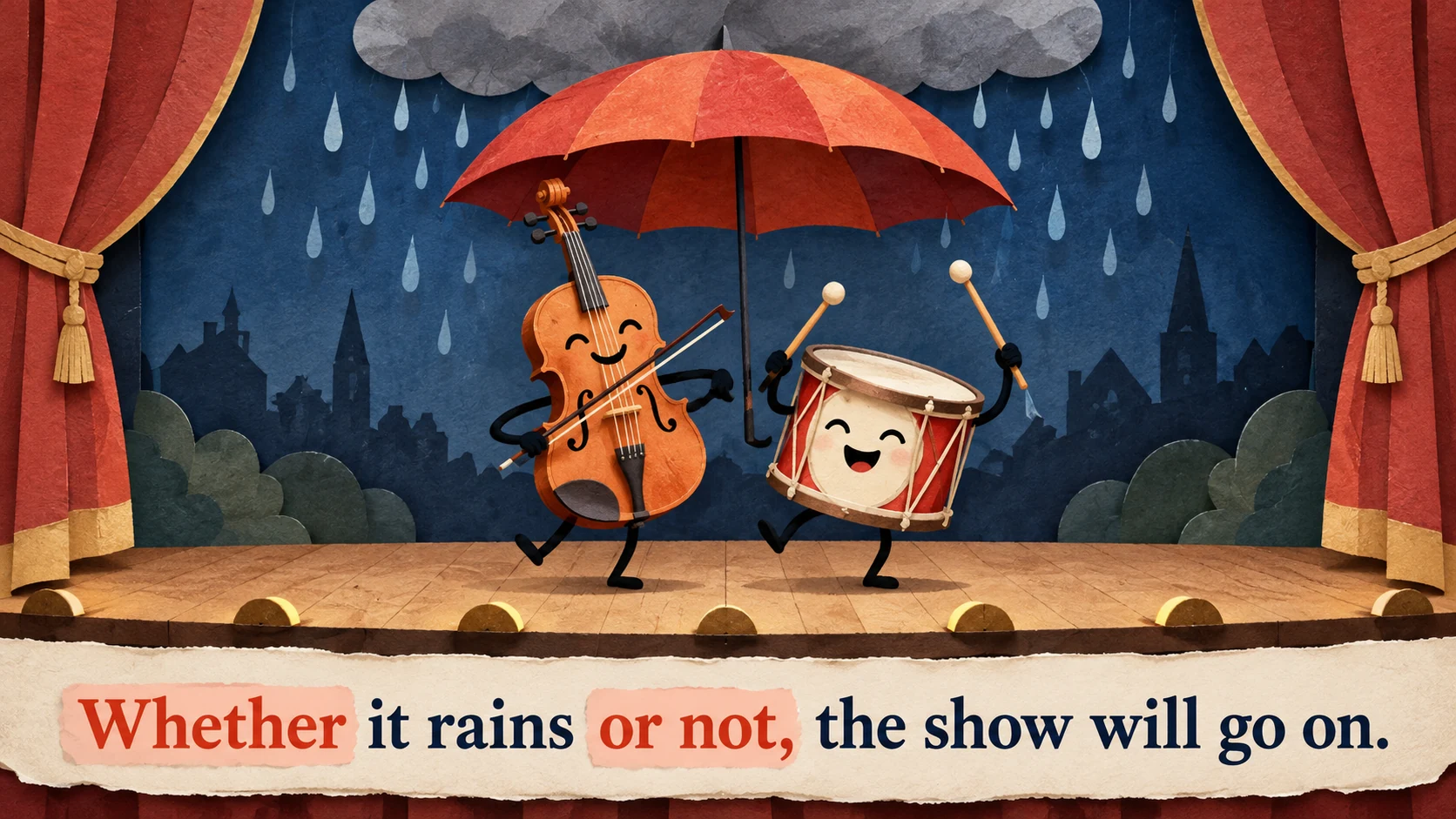
A fact, or a possibility?
Use although / though / even though when you accept the condition as real:
Although the sample was small, the pattern was consistent.
Even though the committee had limited time, it examined every submission.
Use even if when the condition is hypothetical or not yet settled, and the result holds either way:
Even if the next sample is larger, the conclusion will remain provisional.
The next sample may or may not be larger. Even if presents it as a possibility, not as a fact. Compare:
Although the next sample is larger, the conclusion remains provisional.
This treats the larger sample as an actual fact.
Present the alternatives explicitly
Use whether ... or ... when you name alternatives:
Whether the panel approves or rejects the proposal, the review will continue.
The clause already contains both possible outcomes. If you add not, the meaning is still that the result is unchanged: Whether or not the panel agrees, the date will not move.
Use no matter + question word when the range is open:
No matter how carefully the figures are checked, uncertainty remains.
No matter who leads the inquiry, the same evidence will need to be reviewed.
No matter who/what/where/however introduces a full clause, with ordinary statement order: no matter how carefully the figures are checked. Do not use question word order inside it.
Keep the contrast coherent
The main clause should express the outcome that survives the concession. A useful test is to ask whether the second statement remains true in each case named by the first.
Whether the launch is delayed or not, the safety checks must be completed.
The checks are required in both outcomes. If the result changes with the condition, an ordinary conditional is more accurate than a concession.
Common mistakes
- Even although the estimate is uncertain... Choose although or even if; do not combine the two frames.
- Even if the evidence is incomplete, the panel will postpone the decision. This is grammatical, but it means postponement happens in that condition. If the intended meaning is “regardless of the evidence”, use whether the evidence is complete or not.
- No matter how is the report detailed... Keep statement order: No matter how detailed the report is...
- Whether the report supports or not... Give the alternatives a subject and verb: Whether the report supports the claim or not...
Quick check
Choose the best opening.
- The archive is already closed, but visitors can still request a digital copy.
- The committee has not decided whether to publish the names; its decision will not affect the appeal.
- The method may be expensive; the finding will remain valid.
Possible answers:
- Although the archive is closed, visitors can still request a digital copy. The closure is a fact.
- Whether or not the committee publishes the names, its decision will not affect the appeal. The outcome is open.
- Even if the method is expensive, the finding will remain valid. The cost is hypothetical here.
The grammar signals how the speaker views the condition. It does not merely decorate a contrast.
Choose the concession by asking what is already known
The linker tells the reader whether you are presenting a fact, a possibility or a range of alternatives. That distinction matters in careful argument: do not make an uncertain condition sound established, or turn an established fact into a hypothetical one.
| What the speaker assumes | Useful frame | Example |
|---|---|---|
| The condition is true | although / even though + clause | Although the sample was small, the trend was consistent. |
| The condition is possible, but the result holds either way | even if + clause | Even if the next sample is larger, the finding will remain provisional. |
| Two named outcomes make no difference | whether … or … | Whether the panel accepts or rejects the appeal, the archive will stay closed. |
| Any member of a possible range makes no difference | no matter + wh-word | No matter who chairs the review, the same evidence must be considered. |
A quick test: can you paraphrase the opening as despite the fact that? If yes, although/even though is likely. If you mean “in the case that this happens, and also if it does not”, use even if or whether … or not.
Even though the licence has expired, the researchers can access the public archive.
Even if the licence expires, the researchers will retain access to the public archive.
The first says expiry is a fact; the second leaves it open. Contrast this with a normal condition, where the outcome depends on the condition: If the licence expires, the researchers will lose access. That is not concessive because the result changes when the condition changes.
Clause or noun phrase?
Although / even though normally introduce a clause with a subject and verb:
Although the route was longer, the team arrived on time.
Despite / in spite of take a noun phrase or an -ing clause:
Despite the longer route, the team arrived on time.
Despite having limited time, the panel considered every submission.
Do not combine the frames as despite of or despite the route was longer. If you need a full clause after despite, use despite the fact that.
Open-ended concession with however
However + adjective/adverb + subject + verb means “no matter how”:
However carefully the data are checked, some uncertainty remains.
However small the difference appears, it should be reported.
Keep statement order after the adjective: however carefully the data are checked, not however carefully are the data checked. For nouns, use whatever + noun: Whatever explanation is offered, the discrepancy still needs investigation.
Guided practice
Choose a frame that matches the meaning.
- The archive is already closed; the public catalogue is still available.
- The next review might confirm the result or overturn it; a second review is required either way.
- The cost may rise; the decision will not change.
- Make this grammatical: Despite the equipment was old, the measurements were reliable.
Answers and reasoning
- Although the archive is closed, the public catalogue is still available. The closure is presented as a fact.
- Whether the next review confirms the result or overturns it, a second review is required. Both outcomes are named.
- Even if the cost rises, the decision will not change. The rise is possible, not established.
- Although the equipment was old, or Despite the old equipment, the measurements were reliable. A full clause follows although; a noun phrase follows despite.
Concession is not the same as contrast
Although presents a fact that might normally count against the main clause, yet the main result still holds. Whereas / while can simply compare two contrasting facts:
Although the first method was slower, it produced more reliable results.
The first method was slower, whereas the second was more reliable.
The first sentence signals an unexpected result; the second sets two properties side by side. Do not use whereas when you mean “despite this, the outcome still happened” unless the surrounding context makes that relation clear.
A concession can also appear in a shorter phrase:
Despite being slower, the first method produced more reliable results.
In spite of the delay, the team completed the review.
The subject of the -ing phrase should still be recoverable. In Despite being slower, the first method…, the method is slower. If the implied subject could be misread, keep a full clause: Although the first method was slower…
Further reading
Try this structure in a short practice set with instant feedback.
Start practice