Word Formation:
Prefixes, Suffixes & Roots
Part 3 gives you a base word and asks you to transform it to fit the gap. Often you need to change the word class AND add a prefix. This guide covers every transformation you need to know.
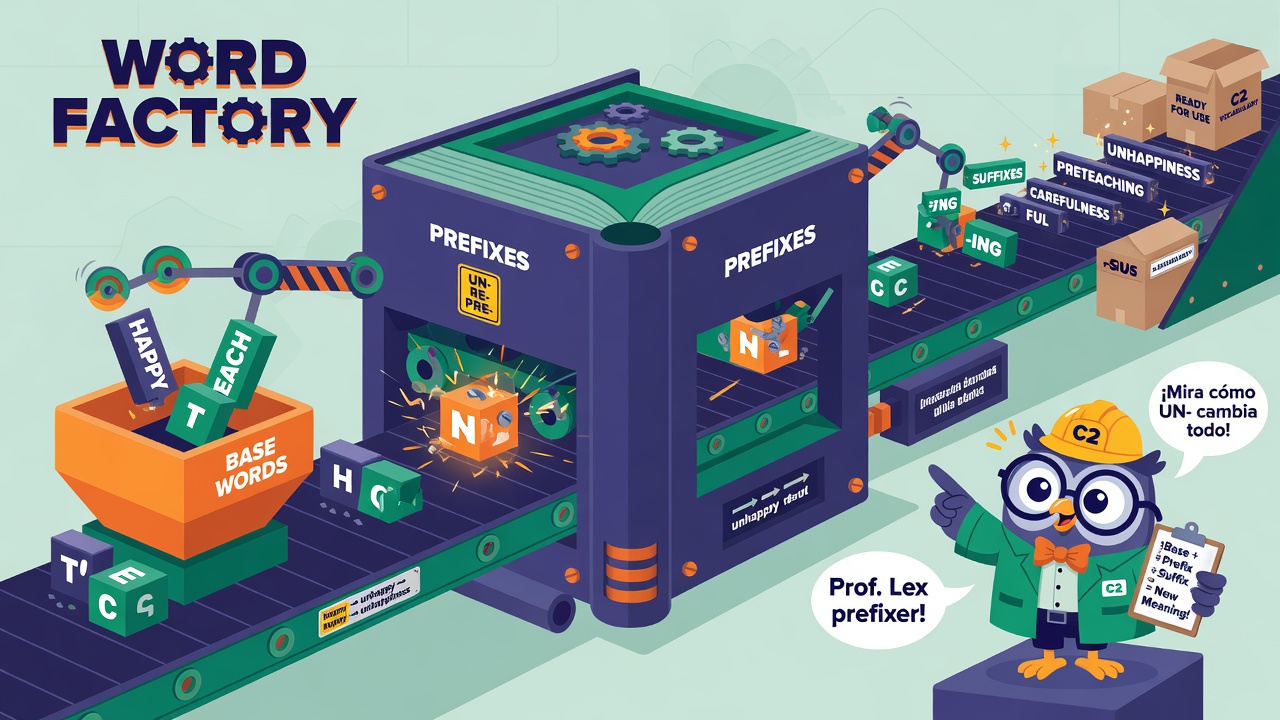
How do you approach C2 Proficiency Part 3 Word Formation?
In 2026, Cambridge C2 Part 3 gives 8 base words to transform into nouns, verbs, adjectives, or adverbs. Ask three questions: what word class is needed, which suffix applies, and whether a negative prefix is required. About 30% of gaps need negative forms.
1What 3 Questions Should You Ask Before Each Gap?
Look at the surrounding words. Article before gap → noun. Before a noun → adjective. Modifying a verb → adverb.
Match the base word to the correct suffix. Remember spelling changes (e.g. happy → happiness, not happyness).
Re-read the sentence. Is the meaning negative? You may need BOTH a prefix AND a suffix applied to the base word.
2Which Suffixes Create Nouns, Adjectives & Adverbs?
Noun Suffixes
-tion / -sionformation, persuasion, reduction-mentachievement, improvement, assessment-nesshappiness, weakness, awareness-ity / -tycreativity, ability, certainty-ance / -enceperformance, existence, significance-ism / -istcriticism, journalist, optimismAdjective Suffixes
-ful / -lesspowerful, meaningful / careless, endless-ive / -ativecreative, communicative, active-ous / -iousambitious, obvious, mysterious-able / -iblereliable, flexible, permissibleVerb Suffixes
-ifyclarify, simplify, intensify-ise / -izerealise, prioritise, organise-enstrengthen, widen, broaden3Why Are Negative Prefixes the #1 Part 3 Trap?
About 30% of Part 3 answers require a negative prefix. Choosing the wrong one (e.g. "unresponsible" instead of "irresponsible") costs marks.
| Prefix | Rule | Examples |
|---|---|---|
un- | Most common — adjectives & past participles | unhappy, unexpected |
in- / im- / ir- / il- | im- before m/p, ir- before r, il- before l | impossible, irresponsible |
dis- | Opposite action for verbs | disagree, disappoint |
mis- | Incorrectly or wrongly | misunderstand, mislead |
over- / under- | Too much / too little | overestimate, underpaid |
4Which Spelling Changes Trip Up C2 Candidates?
y → i before suffix
drop the -e
drop the -e (not "arguement")
not "absorbtion"
-t → -ss before -ion
double r before vowel suffix
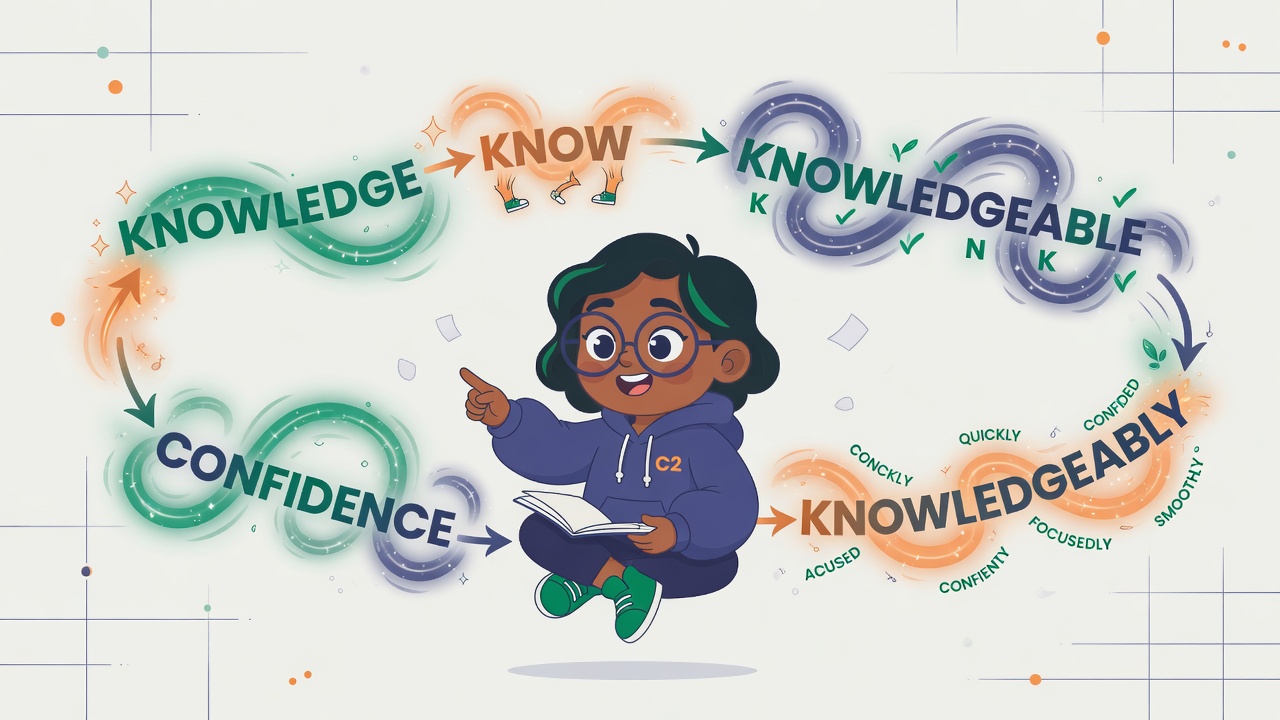
Ready to Test Your Word Formation?
Practise transforming words in context with our free Part 3 exams.
Start Part 3 Practice NowWhere Are Word Formation Rules Defined Officially?
- Cambridge University Press & Assessment: C2 Proficiency Teachers Handbook — retrieved 2026-06-11
- Cambridge University Press & Assessment: C2 Proficiency exam overview — retrieved 2026-06-11
- Cambridge University Press & Assessment: Cambridge English Scale — retrieved 2026-06-11
Related C2 Use of English Guides
Written for Cambridge C2 candidates by José Luis García and checked against the official sources listed above. Last updated: March 2026.